




Imanol Pérez: Air Europa will be attending FITUR 2027 with improvements in service quality and connectivity


FITUR is “a key platform for strengthening relationships with destinations, public authorities, travel agencies and strategic partners, as well as for sharing with the industry the company’s progress and its role in Spain’s tourism connectivity”, says Imanol Pérez, commercial director of Air Europa. Ahead of FITUR 2027, the company hopes to arrive “with tangible progress in the implementation of +Air 28, which will improve service quality and bring new developments in the expansion of its network”. Pérez also explains Air Europa’s plans, challenges and latest developments for the coming years.
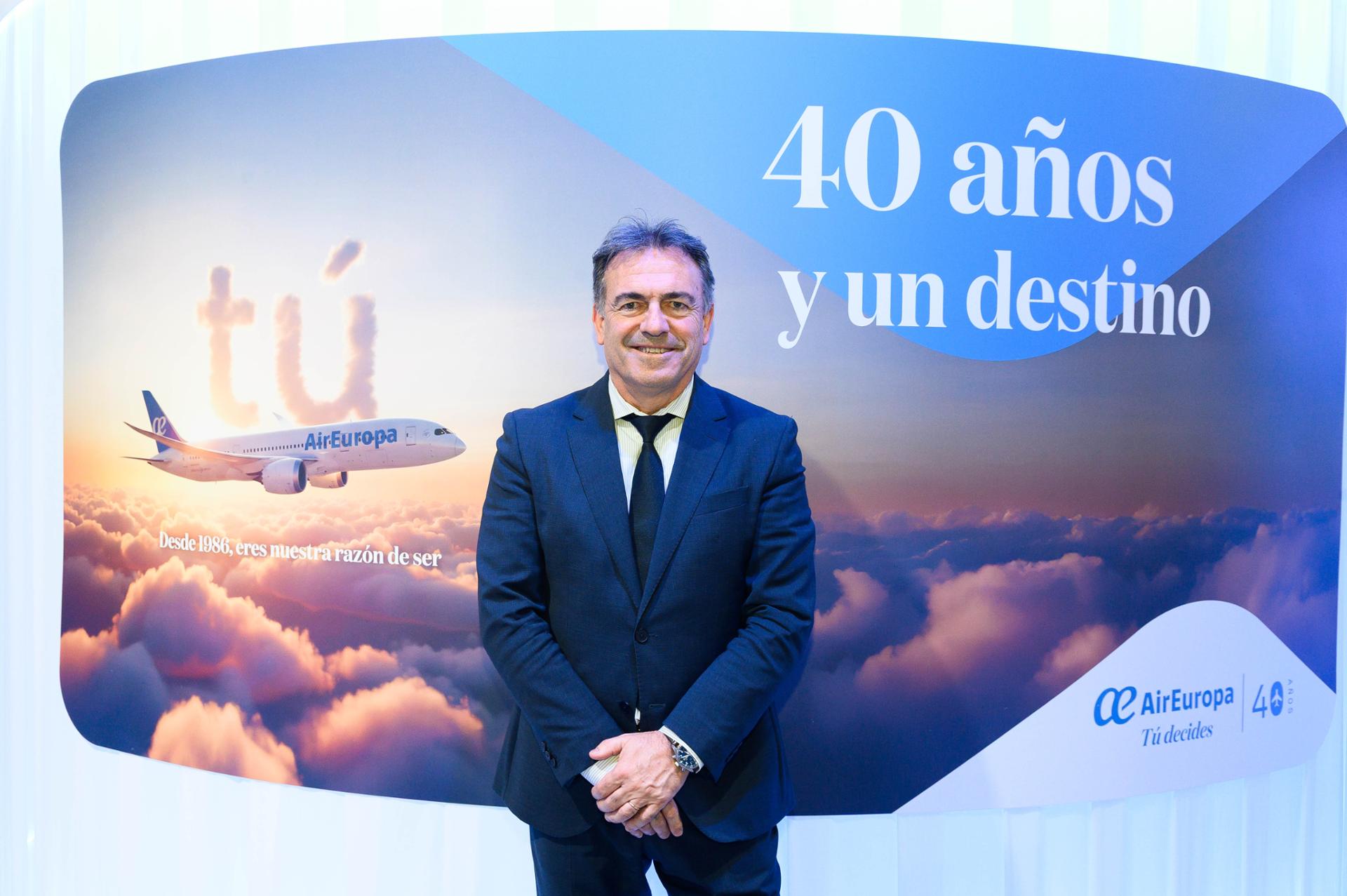
How important are the tourism industry and transport links in Spain to Air Europa?
Tourism is, without a doubt, one of Spain’s major economic, social and cultural drivers. Its significance is not limited to the impact on the economy as a whole resulting from the high volume of visitors to our country: it also promotes our country’s image, creates jobs at all levels, revitalises local areas and drives a very broad value chain.
For Air Europa, tourism and connectivity are inseparable. A competitive economy in this industry requires a robust air network and a hub capable of channelling traffic between source and destination markets. Madrid-Barajas fulfils this role between Europe, the Americas and, increasingly, Africa, whilst Air Europa helps to strengthen it with an increasingly robust network underpinned by a modern and efficient fleet.
What stage is the company currently at, and what are the objectives of its strategic plan?
For the past 40 years, Air Europa has focused primarily on scheduled passenger air transport, playing a particularly important role in connecting Europe and the Americas via its strategic hub at Madrid-Barajas. We operate as a full-service airline, offering domestic, European and transatlantic routes, as well as new opportunities to Africa. We also play an important role in the air freight sector; through our subsidiary, Air Europa Cargo, we have established ourselves in recent years by providing a vital service as the number of transatlantic flights has increased.
The company is now entering a new phase of consolidation and growth, having restored our business operations and strengthened our financial position. We closed 2025 with a record turnover of 3.146 billion euros, a net profit of 111 million and more than 12.5 million passengers carried.
On that basis, we are embarking on a new phase of our +Air 28 strategic plan, aimed at transforming us into a more customer-focused, profitable, efficient and data-driven organisation. This framework is complemented by initiatives such as Air Europa ON, aimed at improving the overall customer service experience; CORE, a global programme for efficiency and competitiveness; Air Europa Technics, to integrate and enhance aircraft maintenance activities; and, finally, the gradual renewal of the fleet, to which the new Airbus A350-900s will be added from 2028.
What major challenges is the industry – and, specifically, your company – currently facing?
The industry’s major global challenges involve effectively navigating a highly flexible market, which is undergoing changes with increasing frequency and at an ever-faster pace. Added to this are global instabilities in certain regions, which affect not only route planning in the short, medium and long term, but also the management and control of costs, such as fuel costs. Furthermore, sustainability will continue to be a key consideration in our decision-making, given our role as key players in the mobility industry at all levels, whilst integrating data management and artificial intelligence as essential tools for achieving more efficient operations.
As far as we are concerned, the main challenge is to turn the recovery into profitable, sustained and orderly growth. It is not just a matter of opening new routes or increasing capacity, but of doing so with discipline, operational efficiency and an ever-improving customer experience. Of course, digitalisation, data-driven planning, punctuality, fleet availability and the ability to meet the needs of increasingly demanding passengers – who expect connectivity, reliability, comfort and personalised services throughout their journey – are proving to be key factors.
What initiatives and changes is Air Europa implementing in 2026?
In 2026, Air Europa is undergoing a far-reaching transformation towards becoming an organisation centred on the customer, profitability and the development of robust and efficient operational processes. We are strengthening our data-driven management culture to optimise decision-making.
This process is structured around our strategic plan and key initiatives such as Air Europa ON, which we have been rolling out since the second quarter of 2026 and through which we are enhancing the customer experience. We are also continuing to make progress with the ongoing renewal of our fleet, with new Boeing 737 MAX aircraft continuing to be delivered for short- and medium-haul routes.
In terms of its network, the company continues to strengthen its global connectivity offering by adding new strategic destinations. This year we have added routes to Seville and Oviedo in Spain, Geneva and Düsseldorf in Europe, as well as Barranquilla and El Salvador in the Americas, not to mention our service to Johannesburg, which makes us the only airline connecting Madrid with this major tourist and business hub in Africa.
What other factors do you consider necessary to improve your competitive position in the market?
Some of the most important issues include digitalisation, sustainability, the importance of having a state-of-the-art fleet, operational efficiency and, undoubtedly, improving the customer experience. All of these form part of the same priority: to compete more effectively without compromising on service quality.
Digitalisation enables more accurate decision-making, allows us to anticipate needs and optimise costs; sustainability requires an efficient fleet and a team committed to process efficiency at all levels; and the customer experience demands offering more options to tailor the journey to suit the user’s preferences, both on board and on the ground, with a Business Class that stands out and an Economy Class that represents a significant leap in quality, in terms of service, comfort and cuisine.
How does the company plan to confront the coming years?
Air Europa is looking ahead to the coming years from a position of strength, having recovered our operations and implemented a strategic plan for steady growth. Our ambition is to establish ourselves as the leading airline between Europe, the Americas and Africa, building on our base at Madrid-Barajas, a more comprehensive network and a distinctive fleet. From here, we help to strengthen Spain’s competitiveness in the tourism industry and its international profile.
How did your participation in the last edition of FITUR contribute to the development of your company and what are your expectations for FITUR 2027?
FITUR is a key platform for strengthening relationships with destinations, public authorities, travel agencies and strategic partners, as well as for sharing the company’s development and its role in Spain’s tourism connectivity with the industry.
Last year’s edition enabled us to highlight the phase we are currently in, characterised by network expansion, operational improvements and new in-flight services, such as our new high-end dining offering on medium-haul domestic routes, created in collaboration with Mario Sandoval. It was also the occasion on which we announced the firm order to add up to 40 A350-900s to our fleet.
Ahead of FITUR 2027, Air Europa hopes to present tangible progress in the implementation of +Air 28, with improvements to service quality and new developments in the expansion of its network.