




The seventh edition of FITURNEXT invites placing water at the heart of sustainable tourism management


During its sessions, the main conclusions of the FITURNEXT Report were presented, based on research and the analysis of nearly 300 projects from around the world.
In addition, the winning initiatives of the FITURNEXT 2026 Challenge were announced: Fundación Visit València, Barceló Regen and Plastic Cup.
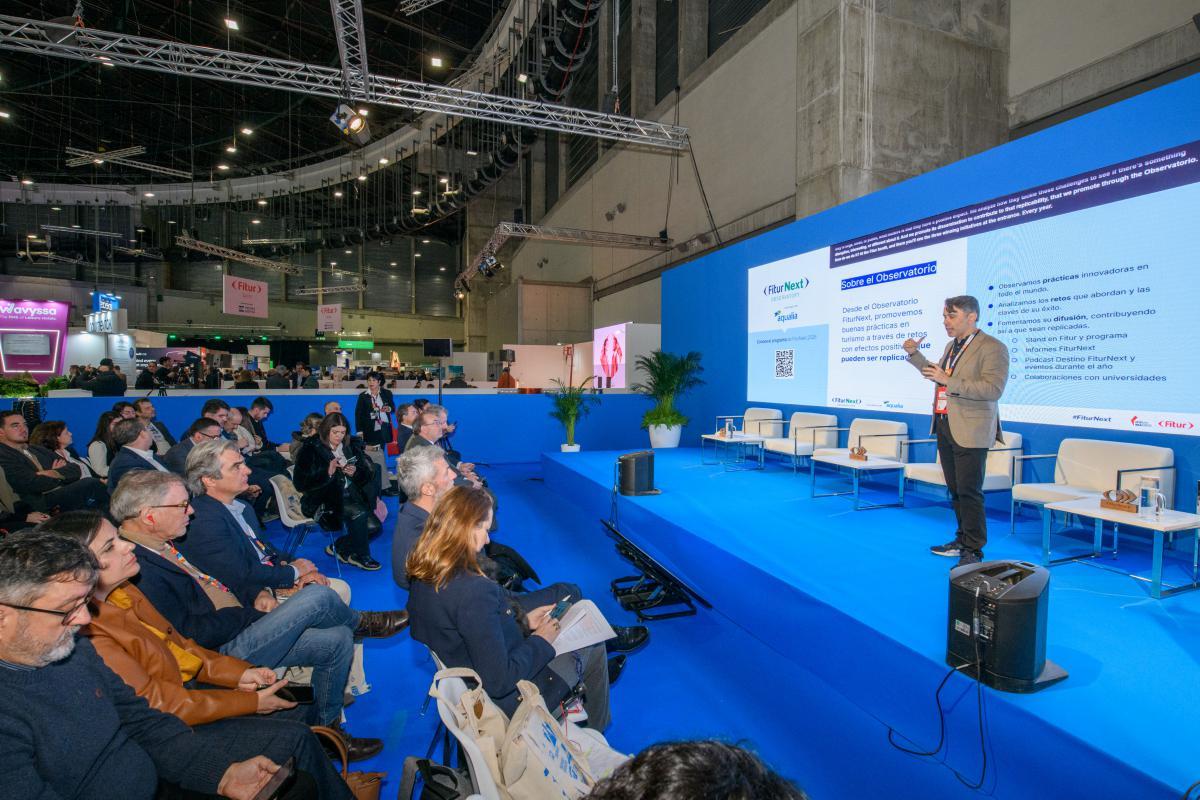
FITURNEXT, FITUR’s Sustainability Observatory, supported by Aqualia, a benchmark brand in the management of the integrated water cycle, has concluded its seventh edition with a focus on water and on the role of tourism as an ally in the sustainable and responsible management of this resource. Throughout its sessions, more than 40 experts from the public and private sectors took part in this forum to share best practices and present innovative solutions and technologies that are already helping to transform the tourism sector.
According to current consumption trends, by 2030 global water demand will exceed supply and half of the world’s population will be living in areas of high water stress. As an economic activity, tourism has a strong dependence on water and a significant impact on the planet’s water resources; therefore, it was explained that tourism can and must also be part of the solution for more efficient water management.
“The water footprint of a tourist can be up to six times greater than that of a resident. Responsible water use cannot be merely an aspiration for tourism in our country; it must be understood as a standard for the sustainability and resilience of companies and destinations, as well as for their development and competitiveness,” said Lucas Díaz, Aqualia’s Country Director for Spain, during the opening session.
The role of tourism in water management
Following the official opening, which was also attended by Jesús Maza, President of the Spanish Association of Urban Water (DAQUAS), and Santiago Quiroga, Director of Quality and CSR at IFEMA MADRID and member of the FITURNEXT Advisory Board, the FITURNEXT 2026 Report was presented.
In this edition, nearly 300 initiatives from around the world were analysed. Through this research, it was possible to break down the pressures that tourism activity exerts on water and to bring to light best practices and strategies to promote the efficient and responsible use of this resource.
In this regard, Francisco Rodríguez, Head of the Tourism Area at Ideas for Change and Coordinator of the Observatory, highlighted three priority pillars of action that must be activated in a combined manner. “On the one hand, public policies that encourage sustainable management; on the other, making the most of the opportunities offered by the latest technological advances, such as robotisation, IoT or AI. And finally, cross-cutting collaboration between different stakeholders, from tourists and residents to companies and public administrations.”
Finalists and winners of the FITURNEXT 2026 Challenge: tourism practices with positive impact
Led by Francisco Rodríguez, the section announced the nine finalist initiatives of the FITURNEXT 2026 Challenge, as well as the three winners: Fundación Visit València, in the Destinations and Other Territories category; Barceló Regen, in the HORECA and Transport Sector category; and Plastic Cup, in the Other Value Chain Stakeholders group.
Fundación Visit València has been recognised for its project to measure and certify the tourism water footprint in the city. Thanks to the analysis, monitoring and optimisation of water consumption derived from visitor activity, the city has achieved a water efficiency rate of 95%, becoming an international benchmark. “At València City Council, we are promoting a tourism model that combines innovation, efficient use of resources and quality of life for residents,” said Paula Llobet, Councillor for Tourism, Innovation and Investment Attraction and Chair of the foundation.
Meanwhile, Barceló Regen, an initiative of the Barceló Group, was awarded for demonstrating that hotel establishments can significantly reduce their water consumption. In recent years, the company has invested in water efficiency improvements such as the installation of flow restrictors, sensors and reuse systems, and has launched awareness campaigns such as Songs 4 Showering, a Spotify playlist featuring four-minute songs designed to encourage shorter showers. For Belén Juárez Gómez, Head of Sustainability at the Group, projects such as this one “show that small everyday actions matter and that, together, through shared responsibility, we can move towards a conscious, regenerative and committed tourism.”
Finally, the Plastic Cup initiative was highlighted for turning the clean-up of rivers and floodplains into a collective tourism activity that has succeeded in removing more than 400 tonnes of river waste from these natural areas, while also promoting environmental education, regenerative tourism and citizen collaboration. As Attila David Molnar, River Cleanup Expert at Plastic Cup, points out, “good tourism goes beyond leaving footprints alone; it helps to restore and improve the place being visited.”
Best practices and innovative solutions for responsible water use
The FITURNEXT sessions also featured additional round tables and talks addressing water management as an urgent challenge for tourism. Among the cases shared, the municipality of Torrox (Málaga) stood out, where its Mayor, Óscar Medina, presented the public–private collaboration developed together with Aqualia to improve supply efficiency and its positive impact on local life.
The reflections were further expanded throughout the professional days with examples from different territories, ranging from the Balearic Islands to Santander and Badajoz, as well as with technological solutions already in place that actively engage travellers in the responsible use of water. Participants agreed on the need to move from isolated initiatives to integrated, long-term strategies that connect water, tourism and sustainability.