




The FITURNEXT Observatory announces the winning initiatives of the 2027 Challenge, focused on how tourism can contribute to preserving and promoting cultural identity


El Cielo de esta Tierra (Monasterio del Olivar), Centro ecoturístico Kííchpam K'áax and Chiuanime Masehual are the winning initiatives in the categories of heritage revitalisation and regeneration, community-led identity tourism initiatives and the creation of identity-based tourism products, respectively.
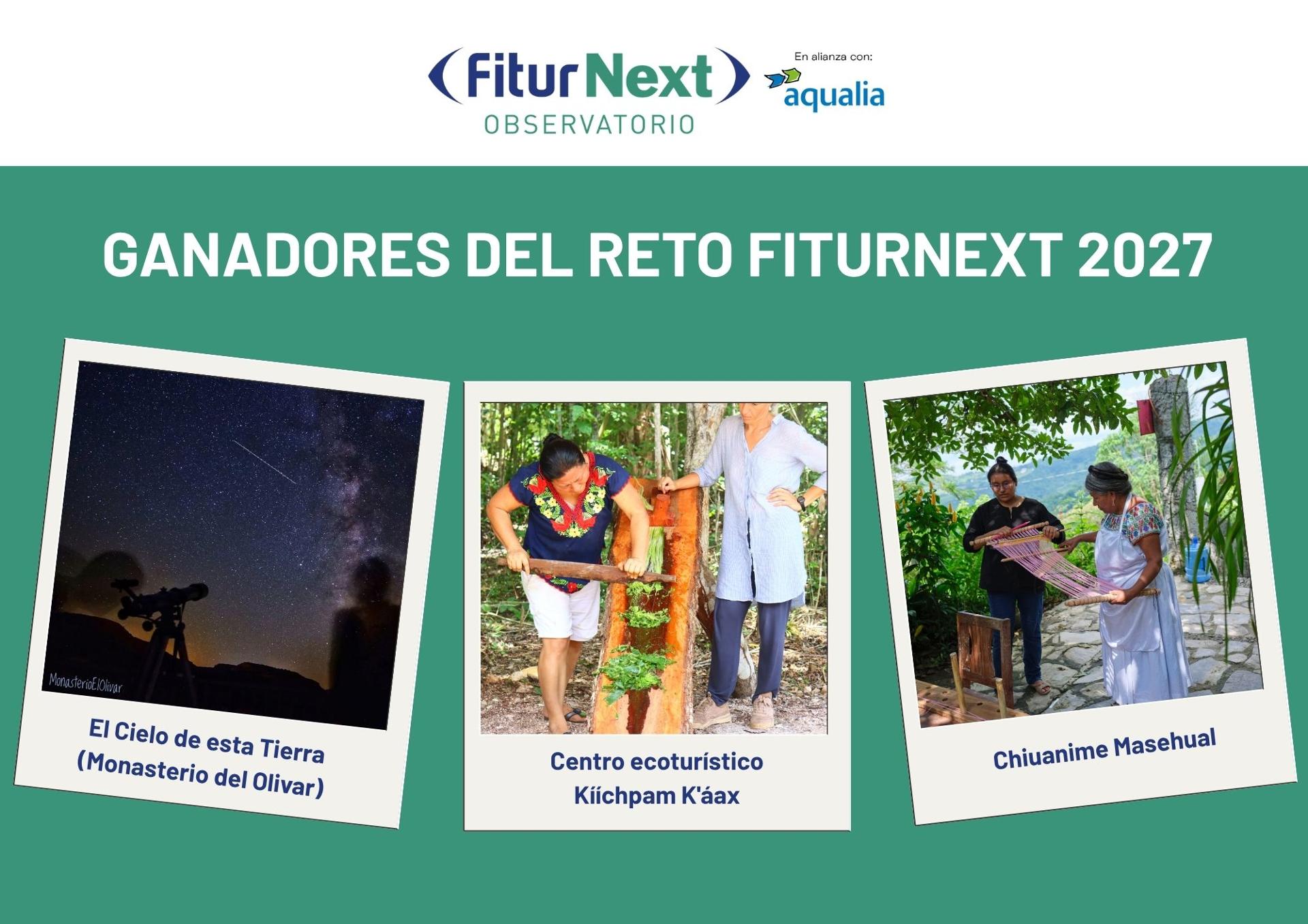
Once again, FITURNEXT, the FITUR Observatory dedicated to promoting good tourism practices in terms of sustainability, has unveiled the winning initiatives of the 2027 Challenge, which this year has focused on how tourism can contribute to preserving and promoting cultural identity. For the third consecutive year, Aqualia, a leading brand in integrated water cycle management, is sponsoring this initiative, recognizing the importance of safeguarding the identity of tourist destinations.
After analysing more than 350 initiatives from five continents, FITURNEXT has recognised the projects of El Cielo de esta Tierra (Monasterio del Olivar) in the heritage revitalisation and regeneration category; Centro ecoturístico Kííchpam K'áax, in community-led identity tourism initiatives; and Chiuanime Masehual in the creation of identity-based tourism products. These projects will be presented on 20 January at the Madrid International Tourism Trade Fair (FITUR), to be held from 20 to 24 January 2027 at IFEMA MADRID.
The assessment is carried out through the FITURNEXT Observatory's own barometers, which measure the impact and replicability of each proposal in order to identify those that best respond to the Challenge. In this edition, the Impact Barometer has examined the governance of each initiative, the economic retention within the territory, the limits the community places on the commodification of its heritage and the role assigned to the visitor, while the Replicability Barometer has determined the maturity of the practice and its viability for application in other tourism contexts.
Winning initiatives committed to the cultural identity of their territories
El Cielo de esta Tierra (Monasterio del Olivar) has been recognised in the heritage revitalisation and regeneration category for turning the night sky into a shared cultural asset. In a living monastery of more than seven centuries in Estercuel (Teruel, Spain), accredited as a Starlight Monastery since 2020, stargazing sessions combine the scientific rigour of the Starlight network with the legends and agricultural knowledge of the territory, rounded off with dinners under the stars, traditional music concerts and silence experiences. All activities are open to local residents, who share them with visitors, so the district has recovered both its appreciation of the starry sky and the traditional knowledge of how the moon affects crops. Revenue sustains the upkeep of the monastery and anchors employment in an area suffering severe depopulation.
Centro ecoturístico Kííchpam K'áax, a cooperative of Maya families in the Yucatán Peninsula, has been awarded in community-led initiatives for replacing a resource-intensive farming economy with a tourism model that neglects neither cultural identity nor the environment. Visitors connect with Maya culture through language, gastronomy and traditional crafts, in direct contact with the member families. What sets the case apart are its explicit limits: certain festivities are excluded from the offer, photographs require the participants' permission and every activity has a set carrying capacity. Together with ten other Maya cooperatives they have created a destination management body which they co-govern, and the territory has grown from seven community tourism promoters to fifteen businesses.
Chiuanime Masehual, a rural production society of Nahua indigenous women in the Sierra Norte de Puebla, has been recognised in identity-based tourism products for rescuing backstrap weaving and hand embroidery at a time when no one was still working the original technique. Under this brand they bring together a craft shop, a traditional restaurant, accommodation and a sewing workshop, and at the Ticoteno gastronomic workshop visitors take part in preparing the dishes. The workshops taught across the whole municipality have multiplied the number of people practising the technique, while the most sacred rituals and the natural places of worship remain outside the offer by decision of the community itself.
2027 Challenge finalists: identity as a reason to stay
In addition to the winning initiatives, nine projects have been selected as finalists of the FITURNEXT 2027 Challenge for their contribution to preserving cultural identity, and will be presented during the FITURNEXT 2027 programme:
- Fundación Río Tinto, Patrimonio Vivo has turned the mining, railway and archival heritage of the Riotinto basin into the engine that sustains its own recovery, with a museum, a twelve-kilometre railway and training workshops that have taught hundreds of local young people.
- Canfranc Estación, a Royal Hideaway Hotel has brought the international station of Canfranc back into use, a listed heritage asset left to decay since 1970, preserving the shell intact and making railway history the backbone of the experience.
- Pescadores de la Prehistoria has been sharing the palaeontological heritage of the Mixteca region of Puebla since 1981 under entirely family-run management, so that neighbours have gone from giving fossils away to donating them to the local museum.
- Hecho en Ozolco brings together eight productive initiatives on the slopes of Popocatépetl, with the Pulque Fair as its centrepiece, and deliberately caps visitor numbers because tourism is one of its activities and not its only livelihood.
- Kapawi Ecolodge is owned by three Achuar communities of the Ecuadorian Amazon that take decisions in assembly according to their ancestral system, and its model has already been replicated by ten neighbouring communities.
- Tejiendo Identidad: De las manos de Barú al corazón del viajero rescues the craft knowledge of female heads of household on the island of Barú through sarongs whose designs spring from their own imagery, and channels ninety-five per cent of the revenue to the artisans.
- Guardianes del Desierto co-creates every activity on its route with the indigenous communities of the Tehuacán-Cuicatlán semi-desert and expressly refuses to stage anything for the visitor.
- Indigenous Artisan Weaving Tour (Awamaki) places the Andean weavers of Ollantaytambo at the centre of the tour. Seventy per cent of the participants now earn an income of their own thanks to their identity.
- Calanoa Amazonas has recovered rituals, sacred spaces and traditional medicine in five communities of the Colombian Amazon thanks to tourism, with a cap of ten visitors a day in the rainforest agreed with them.
The FiturNext 2027 programme, coming soon
As in every edition, the Observatory organises a three-day agenda packed with talks, presentations, conferences and round tables with experts on the theme of the edition. The programme preview will be unveiled shortly, with the awards ceremony on 20 January from 12:30 (CET) and the presentation of the 2027 report as highlights.
About Aqualia
Aqualia is a benchmark brand in the integrated water cycle management sector, positioned as pioneering, specialised, transparent and innovative. Its commitment and responsibility towards the territories where it operates is not limited to service provision: It seeks to contribute to the development of the territories where it provides services and to improve people's well-being, especially that of the most vulnerable groups.