



The First International Summit on Communication and Tourism aims to become “a major global milestone as a source of knowledge for communication and tourism professionals”


Experts examine opportunities in tourism communication, fact-checking in the face of disinformation, and the future of the sector’s narrative
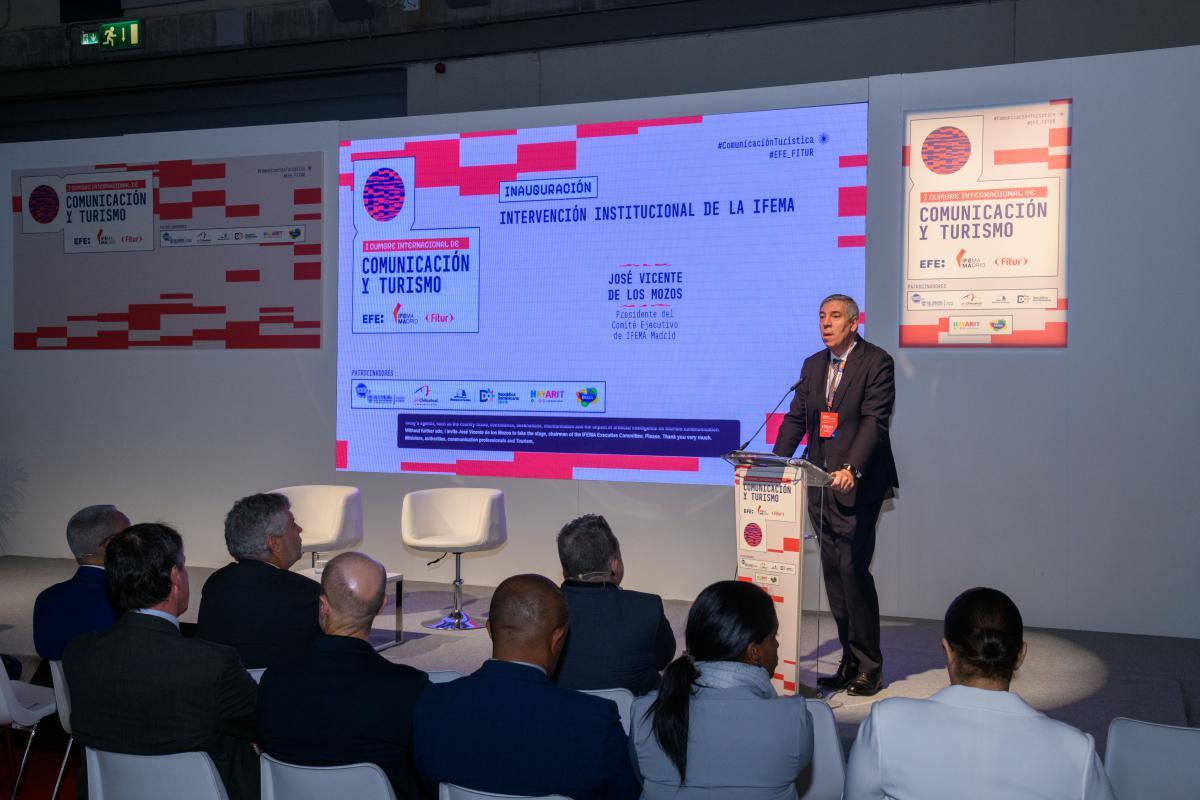
The first International Summit on Communication and Tourism, organized by FITUR and Agencia EFE and held as part of FITUR 2026, took place on Friday with the ambition of becoming “one of the major global milestones as a source of knowledge for professionals in communication and tourism”. This was stated at the opening session by José Vicente de los Mozos, President of the Executive Committee of IFEMA MADRID.
Also speaking at the opening was Miguel Ángel Oliver, President of Agencia EFE, who argued that tourism must be placed “at the centre of economic policy” in a context of “geopolitical uncertainty”. He called on the sector to continue advancing in gender equality, labour inclusion, sustainability, innovation and investment.
Tourism communication in times of uncertainty: the value of country branding
The first panel, focused on tourism communication in times of uncertainty and sponsored by the Ministry of Tourism of the Dominican Republic, highlighted the importance of professional training as a cornerstone for sustaining a strong country brand and delivering effective communication campaigns.
“It is essential to continue investing in training; secondly, to maintain credibility and trust; and thirdly, to communicate well,” said José Luis Sá Nogueira, Minister of Tourism of Cabo Verde. He explained that the country is recruiting professionals as part of its tourism promotion plan ahead of the 2026 FIFA World Cup, for which Cabo Verde has qualified for the first time.
His view was shared by Fernando Valmaseda, CEO of RV Edipress, a tourism-focused communications company, and director of the magazine Miradas Viajeras: “If tourism professionals are not properly trained, they cannot provide quality service or inspire confidence in travellers.” He stressed that tourism communication “is not an expense, but an investment”, adding that “what is not communicated does not exist”.
Living from tourism or surviving tourism: communicating amid ‘tourism-phobia’
The panel Living from tourism or surviving tourism, sponsored by the Secretariat of Tourism of the State of Chihuahua (Mexico), addressed tensions between residents of tourist destinations and visitors. María de Lurdes Vale, Director of Tourism of Portugal in Spain, noted: “When we talk about tourism-phobia, we are talking about human beings against other human beings – not about tourism itself.” She also argued that communication strategies “can no longer be the same, nor can we promote tourism in the same way as before”.
For Diego Barceló, CEO of Comunicación Iberoamericana, it is essential to analyse local residents’ perceptions and concerns: “Sometimes the solution is much simpler than it appears, but it requires listening and understanding.”
During the discussion, Edibray Gómez, Secretary of Tourism of the Mexican state of Chihuahua, called for greater respect for traditional communities, indigenous peoples and cultural heritage.
Misinformation and fake news in tourism
The panel on Misinformation and fake news in tourism, sponsored by Embratur, the Brazilian Tourism Board, addressed the impact of disinformation on destination reputation.Jonathan Gómez, Director General of Tourism for the City Council of Málaga, criticized strategies that rely on influencer marketing “to compete for virality and ‘likes’”, sometimes at the expense of neighbouring destinations.
He recalled how Andalusia was affected by disinformation campaigns featuring images of alleged sharks off the coast of Marbella, which later turned out to be herbivorous fish. The false content negatively impacted the perception of the destination and tourism across the province.
Jorge Ocaña, journalist at EFE Verifica, presented real cases illustrating the damage caused by disinformation, including “non-existent destinations”, manipulated images and scams that generate “false expectations” and economic losses for both travellers and cities.
In response, Nuria Cabrero, Editorial Director of Lonely Planet Spain, emphasized rigour and honesty as “essential values in the fight against misinformation”. She noted that the publisher continues to work “as it has for the past 50 years – verifying and cross-checking all information with reliable sources”.
The future of tourism communication
Telling the stories of local communities and reclaiming the origins of destinations were central themes in the fourth and final panel, focused on the future of tourism communication and sponsored by the Secretariat of Tourism of the State of Nayarit (Mexico).
Juan Enrique Suárez, Secretary of Tourism of Nayarit, explained that public policy in the region seeks to highlight the indigenous populations who have preserved the area “for centuries”, ensuring that visitors understand how local communities live.
Yasmina Laraudogoitia, Head of Public Affairs for Booking.com Spain and Portugal, added that travellers increasingly seek “authentic experiences” that connect with their identity and with local communities.
Within this new communication paradigm, Miguel López-Quesada, President of the Spanish Association of Communication Directors (Dircom), argued that “emotion drives decision-making”. To be effective, he said, communication must adopt a language that is “more visual, shorter and emotionally driven, where emotion outweighs rationality”.
This emotional dominance, he added, leads to “faster responses” when choosing a destination.
A ‘human’ sector and a source of hope
The First International Summit on Communication and Tourism closed with an address by the Executive Director of UN Tourism, Natalia Bayona, who argued that the sector must be ‘more human’ and capable of generating ‘hope
“At a time of great global tension, today more than ever we must support the most human of all sectors so that, through resilience and strength, we can show what we are made of,” Bayona said. She also urged continued leadership in positioning tourism “not only as a strong economic sector, but also as one that generates hope and social cohesion”.
She welcomed the fact that tourism is experiencing one of its strongest periods in terms of growth, investment, visitor arrivals and capital flows. However, she warned that “we must become increasingly authentic. We must return to our values, to storytelling.”
The first edition of the International Summit on Communication and Tourism was an information-focused forum organized by IFEMA MADRID and Agencia EFE, the world’s largest Spanish-language news agency, and brought together leading national and international tourism stakeholders.