


Magalí Arriola
ARCO2045: The Future, for Now
The Future, for Now
“Whenever people talk to me about the weather, I always feel quite certain that they mean something else,” said a character in an Oscar Wilde play. A couple of centuries later, David Lynch began posting short videos featuring the daily weather report for Los Angeles, with blue skies and a range of temperatures. He always signed off by wishing us a great day.
On August 21, 2020, Lynch reported low clouds, explaining that he was wearing dark glasses because the future he was seeing looked very bright. All forecasts are subject to change and should be taken with a grain of meteorological salt. This exhibition pursues the filmmaker’s paradoxical optimism and the immediate, subjective and unstable character of the future and it also suggests that what lies ahead is perhaps a recent memory, the gleam of a double-edged sword. At least For Now, as Nicole Miller’s laser projection spells out in glaring terms.
The exhibition makes use of déjà vu as a strategy to connect two spaces within the fair, where small mise-en-scènes, apparent repetitions, accurate forecasts, prophecies that no one believes, and moments of nostalgia play out. Dave McKenzie’s work – a pedestal on which the previous day’s newspaper is displayed each day – clearly embodies this experience. Given this premise, it’ll be difficult to walk through The Future... without encountering the eye-landscapes, eye-characters, and the blind and visionary eyes of the master Rodolfo Abularach, which are on display in both halls.
Barbara Bloom’s works unfold like stage sets devoid of actors or photographic devices without operators, capturing portraits suspended between foresight and memory. The layering of frozen moments reappears in the paintings by Paulina Olovska, who reclaims the intimate gaze of fashion photographer Deborah Turbeville from the dominant virility of her contemporaries, including the renowned Helmut Newton. Coincidentally, Sylvie Selig worked as the German photographer’s assistant before devoting herself fully to stage design and visual arts. Her theatricality is expressed in paintings, sculptures and mannequins that often evoke scenes and characters loaded with desire and violence, with a somewhat Victorian overtones.
The industrial and organic forms juxtaposed in June Crespo‘s sculptures reference fragmented bodies, stripped of all narrative scaffolding. The hybrid or fractured bodies by Heike Kabish and Milena Múzquiz’s ceramic ensemble contrast their softness with Crespo’s rigorous forms. The works of these artists share a surprisingly ominous character that isn’t apparent at first glance.
In his paintings, Akira Ikezoe turns to humor, creating diagrams whose implacable and absurd logic tells the bizarre story of the Coconut Heads as they visit three New York museums. Thomas Hirschhorn challenges us to measure the past by provocatively referencing the empowering potential of art. Patricia Fernández looks back, and even further back, to build her own lineage by literally framing original engravings by Francisco de Goya with wood carved by her grandfather and herself, transforming a historic artwork into a family tale. This game of appropriation has cruder echoes in Candice Lin’s food scenes: dismemberments, family dinners with Henry Kissinger’s head, and even edible drawings that magnify the commercial context of any art fair.
The works by Liv Schulman and Alessandro Balteo Yazbeck refer to those same predatory economies. Schulman’s Hombres argentinos (Argentinian Men) from the series La depresión (Depression) y La deuda (Debt) establishes, in the artist’s own words, “a dialogue on the future of the national debt, depression as a bargaining chip and a particular theatricality that allows us to consider craft – a task historically performed by women – as a potential way to correct failed models.” The Last Oil Barrel, by Balteo Yazbeck, is a miniature sculpture produced as an unnumbered and unlimited edition with its date postponed. This apparent souvenir from an oil-producing country takes on another dimension in relation to Ali Eyal's paintings, based on memories of the artist’s childhood in a Baghdad besieged by US military operations in Iraq in the 1990s and early 2000s. On his canvases, José Luis Sánchez Rull also alludes to the tension between trauma and memory, where text and image become a form of exorcism and a performance of survival. Roi Soleil (The Sun King), a video installation by Albert Serra, recreates the endless agony of Louis XIV, the pinnacle of absolutism, an allegory of decadence that strikes a particular chord in these times of rising authoritarianism.
From this interlacing of works and discourses, as promising and unreliable as a weather report, the future looks like a stage bathed in the dim, fickle light of Allora & Calzadilla's Lightbound. Inspired by the ability of rainforest vines to adapt to their environment by climbing in search of light, these blown-glass pieces intertwined with fiber optics explore our relation to nature and technology. Their pulsing reflects the city’s electrical load while also conveying the sensory and collaborative logic between species, including our own. Slowly, it reveals a form of resistance that is built one day at a time.
Have a great day!
Magalí Arriola and José Luis Blondet
Curators:
Opening. New galleries
Opening. New galleries unfolds this year as a terrain where instability becomes fertile ground, and the present—fragmented and accelerated—emerges as a space for invention, connection, and resistance. Here, art does not offer certainties, but operates within the conditions of the now.
This year, Opening. New galleries positions itself as a framework for reading the present, bringing together 19 young galleries from Athens, Buenos Aires, Bombay, Cape Town, Dakar, Espinavessa (Empordà), Istanbul, Lisbon, Ljubljana, London, Lucerne, Madrid, New York, Paris, Rome, San Sebastián, and Tbilisi. Rather than presenting a unified panorama, the selection traces a fragmented map of artistic practices which, despite their diverse contexts, share a common temporal condition.
Curated by Anissa Touati and Rafael Barber Cortell, with the support of Cristina Anglada, this edition of Opening. New galleries is conceived as a platform for thinking alongside artistic practices produced from what the curatorial team describes as a “state of presentness”: a condition shaped by acceleration, instability, and the growing difficulty of projecting stable futures. Within this framework, the present ceases to function as a point of passage and instead becomes the primary site of action—one in which artistic practices operate in direct contact with uncertainty and constant transformation, in a context where the promise of the future is endlessly postponed.
The practices brought together in the section thus unfold within a context marked by structural precarity, accelerated visibility, and a persistent sense of exposure. In a cultural ecosystem deeply mediated by social networks and the expanding influence of technologies such as artificial intelligence, the circulation of images and narratives follows fragmented and ephemeral logics. From this perspective, the curatorial line brings into dialogue practices that treat these conditions not as obstacles, but as points of departure for thinking and making. In doing so, Opening. New galleries also questions entrenched categories within the art system, such as centre and periphery or the idea of a generation defined by fixed temporal frameworks. The practices presented are articulated across multiple territories and affective, digital, and professional networks that redraw the geographies of emerging art, foregrounding mobile affinities and temporary communities. Art is thus understood as a space of collective rehearsal, distancing itself from the linear epic of past, present, and future.
Of the 19 participating galleries, six return from the previous edition and twelve take part in ARCOmadrid for the first time. This year’s participants are Callirrhoë (Athens), El Chico (Madrid), Kali (Lucerne), OG Gallery (Istanbul), 4710 Gallery + Window Project (Tbilisi), Des Bains (London), Linse (Buenos Aires), Ravnikar (Ljubljana), Exo Exo (Paris), Spiritvessel (Espinavessa, Empordà), Reservoir (Cape Town), dialogue (Lisbon), Gratin (New York), Villa Magdalena (San Sebastián / Madrid), ADA (Rome), Selebe Yoon (Dakar), Method (Bombay), and Enhorabuena Espacio (Madrid).
From this shared state of presentness, the projects presented in Opening unfold as a constellation of gestures, narratives, and material approaches that, across diverse geographical and cultural contexts, activate forms of resistance, belonging, and meaning-making. Georgian galleries 4710 Gallery and Window Project present a group project that approaches ecology as a system of symbolic persistence—gestures, rituals, and modes of transmission that endure over time and contribute to the formation of community. Works by Rusudan Khizanishvili, Tamar Nadiradze, Uta Bekaia, and Merab Gugunashvili operate through the everyday and the ritual as spaces where collective memory is reactivated against the logic of obsolescence.
From a geographically distant context, yet sharing this attention to ritual as a site of collective creation, Victor Jaenada (Spiritvessel) approaches flamenco as a communal, mutable, and apocryphal cultural construction, in which bodies and objects interact to produce a shared whole. Popular memory and intergenerational transmission also surface in the works of Fatim Soumaré and Alioune Diouf (Selebe Yoon), two artists from different generations who construct contemporary narratives through the intimacy of textiles and the universality of painting.
This intergenerational tension also runs through the project presented by Reservoir, featuring works by Seretse Molestane and Marsi van der Heuvel as a dialogue between unsynchronised materialities and temporalities. From painterly abstraction using materials such as earth to family archive photography, their practices articulate a present built from layers of memory, transmission, and inherited experience. In a similar vein, the painting of Max Jahn (Gratin) inhabits the intimacy of the familial to think of identity as a relational and continuously shifting process, where proximity and affect become tools for situating oneself within a present that is not given, but constructed.
The notion of home emerges as a fragile and constantly negotiated space in the works of Sajid Wajid Shaikh, Shamir Iqtidar, Ammama Malik, and Ali Sarvat Jafri, artists represented by Method (Bombay). Rather than conceiving home as a stable or protected site, their works frame it as an intergenerational construction shaped by precarity, care, and exposure—where promises of safety are repeatedly put to the test. Home thus operates as a metaphor for the present itself: a provisional space sustained through bonds, gestures, and affects, from which forms of belonging must be continuously reimagined.
Other projects engage more directly with the languages of a hyperconnected present and cognitive capitalism. Works by Julia Padilla (Linse), Ash Love, and Yann Stéphane Bisso (Exo Exo) explore a hybrid, fragmented, and disoriented present in which intuition emerges as a compass once images have lost their capacity to offer certainty. Along similar lines, Michele Gabriele (Kali) constructs scenarios where fiction gives rise to hybrid realities articulated through matter and its relationship to space and time, while Janis Rafa (Callirrhoë) focuses on how capitalist desire structures narratives, tastes, and affects, producing algorithms that delimit contemporary forms of pleasure.
Collaboration and the creation of shared languages run through the section via two projects commissioned specifically for the Opening section: one by Nevena Aleksovski and Maja Babič Košir (Ravnikar), and another by Estefanía B. Flores and Irene Anguita (El Chico). Both understand art as a space of encounter from which to resist the automation of the present.
Enhorabuena Espacio brings together Peruvian artists Esteban Igartua and Venuca Evanán in a dialogue that explores the relationships between body, memory and territory. Igartua’s painting engages with the organic and the human as mutable surfaces in constant transformation, while Evanán revisits the traditions of Sarhua Tables through a contemporary critical lens, weaving political, erotic and migratory narratives into her practice.
Fiction as a critical tool appears in the works of Blanca Gracia and Marco Eusepi (ADA), who, through sculpture and painting, activate archives from the past to imagine alternative presents that challenge hegemonic narratives. Meanwhile, bodily memory runs through the work of Turkish artist Sıla Candaşayar (Villa Magdalena), whose sculptures and objects propose intuition and embodied experience as ways of imagining other possibilities beyond predetermined narratives. The abstract painting of Defne Cemal (OG Gallery) centres on materiality and perception, situating the viewer’s body within a direct experience of the present.
Within this terrain of friction between matter, body, and systems of symbolic production sit the works of Francesco Pacelli and Sophie Jung (Des Bains), who approach matter not as a stable fact but as an argument under tension. Pacelli’s graphite cosmologies examine bodies under pressure and environments in flux, drawing on science, myth, and industrial processes, while Jung’s assemblages disrupt familiar symbols through humour and misalignment, producing provisional bodies that resist normative behaviour. This same friction shapes the dialogue between Priscila Fernandes and Mike Bouchet (dialogue), whose practices articulate a critique of contemporary regimes of production, pleasure, and consumption, foregrounding the porous boundaries between work and play, intimacy and excess, desire and critique.
Taken as a whole, Opening. New galleries 2026 unfolds as a space in which instability becomes the only viable position from which to act. Rather than attempting to resolve uncertainty, the works presented reveal it as fertile ground for the invention of new transgenerational bonds, conceiving territory as a hybrid, transborder space from which forms of resistance may emerge. Here, art does not provide answers, but opens up possibilities—fleeting moments of meaning that arise from inhabiting this state of presentness.
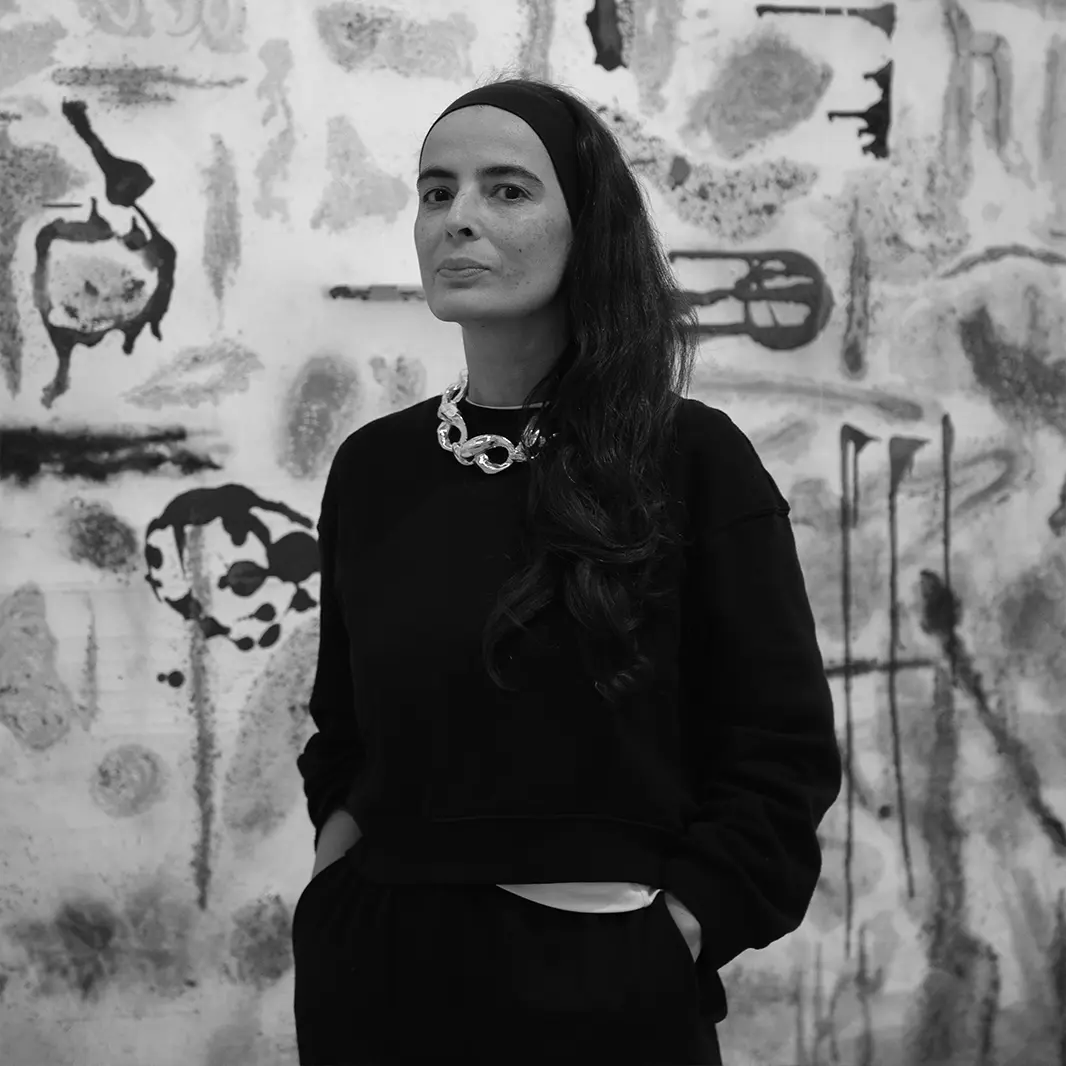
Curators:
Institutional Liaison and Advisor:
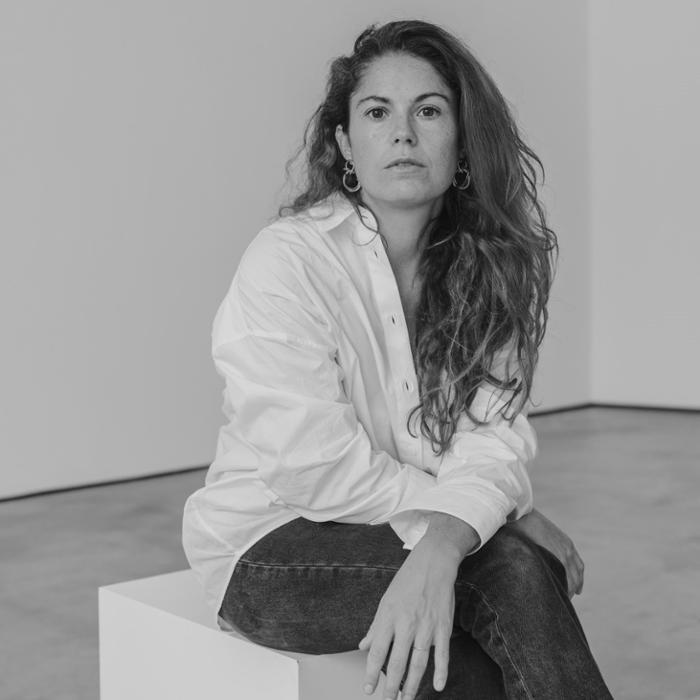
Cristina Anglada
Profiles | Latin American Art
This selection of artists offers an approach to practices that, although from different contexts, generations and languages, share a precise attention to how art is produced in relation to society, material and experiences. Conceived as a section of individual presentations, Perfiles (“Profiles”) invites visitors to pause and carefully study the work of each artist, given that the single booth is a space for concentration and expanded reading within the framework of the fair.
Bringing together emerging and consolidated trajectories, as well as individual and collaborative practices, the artists presented here are not grouped by style or discourse but by a common sensitivity to the contexts in which they operate. Their works dialogue with local stories, shared memories and specific political tensions, questioning national borders and activating resonances that allow us to think of Latin American art as a multi-faceted, established and constantly changing field.
Agustina Woodgate (Barro, Argentina) has developed a practice focused on the analysis of systems, power relationships and theories of value that structure social life. Through sculptures, public interventions and actions of a playful and precise nature, she transforms maps, coins and discarded materials to dismantle institutional paradigms and reconfigure the ways in which public and private space are inhabited and understood.
Ana Claudia Almeida (Quadra, Brazil) works with painting, sculpture and video, exploring memory and corporeality through open material processes. By allowing her materials to fold, shift and accumulate, and by preserving traces of actions, her work uses abstraction as a tool to question the systems that shape the body and everyday life.
Gabriel Branco (Galatea, Brazil) works with painting and analogue photography, developing two distinct but deeply connected practices. While his photography is based on an autobiographical observation of urban life in São Paulo, his abstract painting – constructed through glazes and gradations of light – functions as an interior response, where body, form and luminosity suspend time and meaning.
Harold Mendez (Commonwealth and Council / Patron, USA) addresses history and memory through photography, sculpture and installation, combining research and archival materials from different places. His work explores the tensions between visibility and absence, fiction and truth, by examining how geography, rituals and erased histories shape a transnational experience marked by cultural memory.
Julia Gallo (Yehudi-Hollander Papi, Brazil) has developed a practice that straddles both action and volume, where the movement of the body is translated into sculptural forms and intense marks on paper, charcoal and metal. Its surfaces balance fragility and strength, density and lightness, constructing an imagery of anatomical radicality that evokes a deeply bodily and psychological experience.
Kelton Campos Fausto (A Gentil Carioca, Brazil) has developed a multidisciplinary practice that spans painting, video, ceramics and performance, articulating images that lie somewhere between the fantastic and the disturbing. From references to Afro-Brazilian deities and spirits to non-rational forms of knowledge, his work proposes other ways of understanding the body, energy and the transition between life and death, destabilising normative readings of reality.
Las Nietas de Nonó (Embassy, Puerto Rico), the Afro-diasporic duo formed by Mulowayi and Mapenzi have developed a practice that combines performance, personal archive, organic materials and installation. Through established fiction and micronarratives, their work evokes ancestral memories to address processes of expropriation, colonial violence and environmental justice, providing an intimate and geopolitical voice from the Caribbean perspective.
Miguel Cintra Robles (NASAL, Ecuador) has developed a practice that makes use of sculpture, agriculture and pedagogy as forms of collective learning linked to the land. Through walks, activations and community projects, his work combines biology, ecology and territorial politics, proposing models of socialisations based on the interdependence between bodies, ecosystems and established knowledge.
Paloma Contreras Lomas (Pequod, Mexico) is a visual artist and writer whose practice spans video, installation and drawing. Through humour and narration, her work constructs visual fictions that intertwine desire, violence and performance, bringing together domestic life, popular language and politics in scenes set in Latin American contexts.
Patricia Rengifo (Crisis, Peru) is a Shipibo-Konibo artist whose practice draws on a heritage deeply linked to her community’s memory and knowledge. Through painting and knowledge passed down through the family, her work encompasses the aesthetic and spiritual dimensions to evoke a process of recovery and projection of a cultural legacy in continuity.
Roberto Jacoby (Isla Flotante, Argentina) is a pioneer of Argentine conceptual art whose work has explored the intersection between art, media, politics and sociology since the 1960sy. Through projects, texts and actions that dematerialise the object and propose strategies of resistance and joy, his work questions the relationships between perception, communication and social life, expanding the role of art beyond traditional formats.
Far from offering a closed definition, Profiles | Latin American Art proposes a series of partial approaches that focus on the specificity of each practice. Taken together, these presentations reveal how the art produced in Latin America and by its diasporas is constructed on the basis of established relationships, shared tensions and ways of doing things that do not seek to be representative but are deeply involved in the contexts where they originate and in the dialogues that open up beyond them.
José Esparza Chong Cuy
Curators:
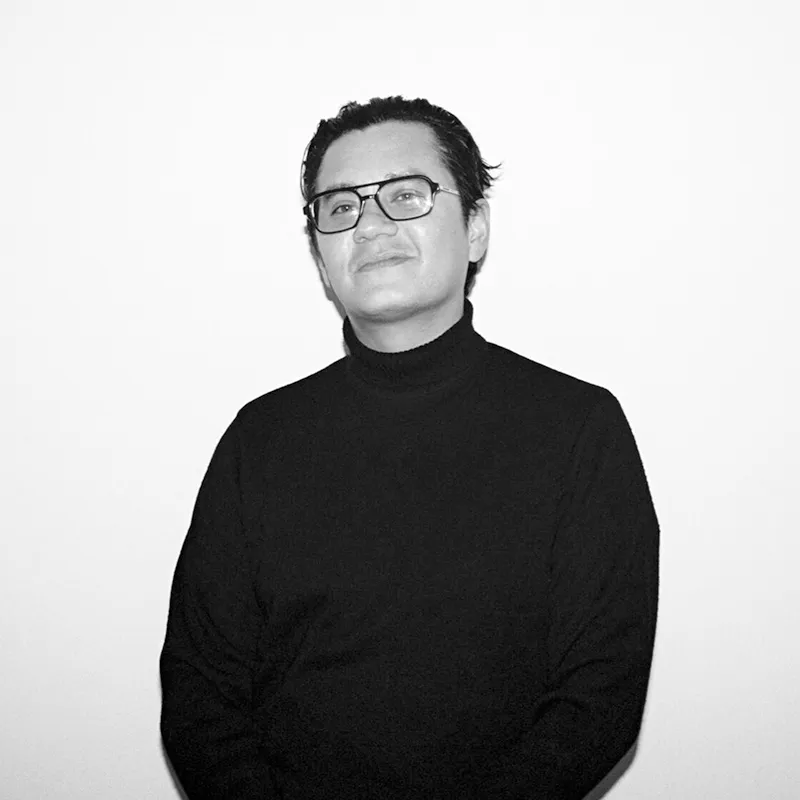
José Esparza Chong Cuy