
Opening. New galleries


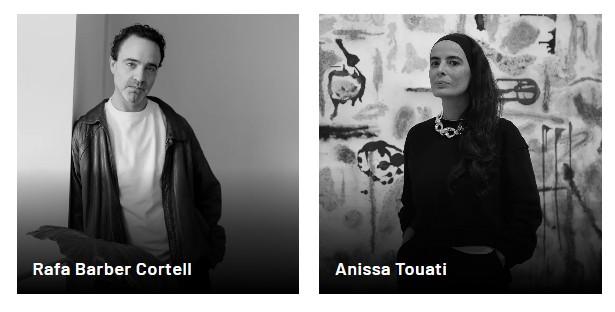
Curators: Rafael Barber Cortell and Anissa Touati
Advisor and Institutional Link: Cristina Anglada
Opening. New galleries unfolds this year as a terrain where instability becomes fertile ground, and the present—fragmented and accelerated—emerges as a space for invention, connection, and resistance. Here, art does not offer certainties, but operates within the conditions of the now.
This year, Opening. New galleries positions itself as a framework for reading the present, bringing together 18 young galleries from Athens, Buenos Aires, Bombay, Cape Town, Dakar, Espinavessa (Empordà), Istanbul, Lisbon, Ljubljana, London, Lucerne, Madrid, New York, Paris, Rome, San Sebastián, and Tbilisi. Rather than presenting a unified panorama, the selection traces a fragmented map of artistic practices which, despite their diverse contexts, share a common temporal condition.
Curated by Anissa Touati and Rafael Barber Cortell, with the support of Cristina Anglada, this edition of Opening. New galleries is conceived as a platform for thinking alongside artistic practices produced from what the curatorial team describes as a “state of presentness”: a condition shaped by acceleration, instability, and the growing difficulty of projecting stable futures. Within this framework, the present ceases to function as a point of passage and instead becomes the primary site of action—one in which artistic practices operate in direct contact with uncertainty and constant transformation, in a context where the promise of the future is endlessly postponed.
The practices brought together in the section thus unfold within a context marked by structural precarity, accelerated visibility, and a persistent sense of exposure. In a cultural ecosystem deeply mediated by social networks and the expanding influence of technologies such as artificial intelligence, the circulation of images and narratives follows fragmented and ephemeral logics. From this perspective, the curatorial line brings into dialogue practices that treat these conditions not as obstacles, but as points of departure for thinking and making. In doing so, Opening. New galleries also questions entrenched categories within the art system, such as centre and periphery or the idea of a generation defined by fixed temporal frameworks. The practices presented are articulated across multiple territories and affective, digital, and professional networks that redraw the geographies of emerging art, foregrounding mobile affinities and temporary communities. Art is thus understood as a space of collective rehearsal, distancing itself from the linear epic of past, present, and future.
Of the 18 participating galleries, six return from the previous edition and twelve take part in ARCOmadrid for the first time. This year’s participants are Callirrhoë (Athens), El Chico (Madrid), Kali (Lucerne), OG Gallery (Istanbul), 4710 Gallery + Window Project (Tbilisi), Des Bains (London), Linse (Buenos Aires), Ravnikar (Ljubljana), Exo Exo (Paris), Spiritvessel (Espinavessa, Empordà), Reservoir (Cape Town), dialogue (Lisbon), Gratin (New York), Villa Magdalena (San Sebastián / Madrid), ADA (Rome), Selebe Yoon (Dakar), Method (Bombay), and Enhorabuena Espacio (Madrid).
From this shared state of presentness, the projects presented in Opening unfold as a constellation of gestures, narratives, and material approaches that, across diverse geographical and cultural contexts, activate forms of resistance, belonging, and meaning-making. Georgian galleries 4710 Gallery and Window Project present a group project that approaches ecology as a system of symbolic persistence—gestures, rituals, and modes of transmission that endure over time and contribute to the formation of community. Works by Rusudan Khizanishvili, Tamar Nadiradze, Uta Bekaia, and Merab Gugunashvili operate through the everyday and the ritual as spaces where collective memory is reactivated against the logic of obsolescence.
From a geographically distant context, yet sharing this attention to ritual as a site of collective creation, Victor Jaenada (Spiritvessel) approaches flamenco as a communal, mutable, and apocryphal cultural construction, in which bodies and objects interact to produce a shared whole. Popular memory and intergenerational transmission also surface in the works of Fatim Soumaré and Alioune Diouf (Selebe Yoon), two artists from different generations who construct contemporary narratives through the intimacy of textiles and the universality of painting.
This intergenerational tension also runs through the project presented by Reservoir, featuring works by Seretse Molestane and Marsi van der Heuvel as a dialogue between unsynchronised materialities and temporalities. From painterly abstraction using materials such as earth to family archive photography, their practices articulate a present built from layers of memory, transmission, and inherited experience. In a similar vein, the painting of Max Jahn (Gratin) inhabits the intimacy of the familial to think of identity as a relational and continuously shifting process, where proximity and affect become tools for situating oneself within a present that is not given, but constructed.
The notion of home emerges as a fragile and constantly negotiated space in the works of Sajid Wajid Shaikh, Shamir Iqtidar, Ammama Malik, and Ali Sarvat Jafri, artists represented by Method (Bombay). Rather than conceiving home as a stable or protected site, their works frame it as an intergenerational construction shaped by precarity, care, and exposure—where promises of safety are repeatedly put to the test. Home thus operates as a metaphor for the present itself: a provisional space sustained through bonds, gestures, and affects, from which forms of belonging must be continuously reimagined.
Other projects engage more directly with the languages of a hyperconnected present and cognitive capitalism. Works by Julia Padilla (Linse), Ash Love, and Yann Stéphane Bisso (Exo Exo) explore a hybrid, fragmented, and disoriented present in which intuition emerges as a compass once images have lost their capacity to offer certainty. Along similar lines, Michele Gabriele (Kali) constructs scenarios where fiction gives rise to hybrid realities articulated through matter and its relationship to space and time, while Janis Rafa (Callirrhoë) focuses on how capitalist desire structures narratives, tastes, and affects, producing algorithms that delimit contemporary forms of pleasure.
Collaboration and the creation of shared languages run through the section via two projects commissioned specifically for the Opening section: one by Nevena Aleksovski and Maja Babič Košir (Ravnikar), and another by Estefanía B. Flores and Irene Anguita (El Chico). Both understand art as a space of encounter from which to resist the automation of the present.
Enhorabuena Espacio brings together Peruvian artists Esteban Igartua and Venuca Evanán in a dialogue that explores the relationships between body, memory and territory. Igartua’s painting engages with the organic and the human as mutable surfaces in constant transformation, while Evanán revisits the traditions of Sarhua Tables through a contemporary critical lens, weaving political, erotic and migratory narratives into her practice.
Fiction as a critical tool appears in the works of Blanca Gracia and Marco Eusepi (ADA), who, through sculpture and painting, activate archives from the past to imagine alternative presents that challenge hegemonic narratives. Meanwhile, bodily memory runs through the work of Turkish artist Sıla Candaşayar (Villa Magdalena), whose sculptures and objects propose intuition and embodied experience as ways of imagining other possibilities beyond predetermined narratives. The abstract painting of Defne Cemal (OG Gallery) centres on materiality and perception, situating the viewer’s body within a direct experience of the present.
Within this terrain of friction between matter, body, and systems of symbolic production sit the works of Francesco Pacelli and Sophie Jung (Des Bains), who approach matter not as a stable fact but as an argument under tension. Pacelli’s graphite cosmologies examine bodies under pressure and environments in flux, drawing on science, myth, and industrial processes, while Jung’s assemblages disrupt familiar symbols through humour and misalignment, producing provisional bodies that resist normative behaviour. This same friction shapes the dialogue between Priscila Fernandes and Mike Bouchet (dialogue), whose practices articulate a critique of contemporary regimes of production, pleasure, and consumption, foregrounding the porous boundaries between work and play, intimacy and excess, desire and critique.
Taken as a whole, Opening. New galleries 2026 unfolds as a space in which instability becomes the only viable position from which to act. Rather than attempting to resolve uncertainty, the works presented reveal it as fertile ground for the invention of new transgenerational bonds, conceiving territory as a hybrid, transborder space from which forms of resistance may emerge. Here, art does not provide answers, but opens up possibilities—fleeting moments of meaning that arise from inhabiting this state of presentness.
Rafael Barber Cortell and Anissa Touati
Rafa Barber Cortell
Rafa Barber Cortell es comisario independiente y escritor, con base entre Londres y Madrid. Su práctica Rafa Barber Cortell is an independent curator and writer based between London and Madrid. His practice combines fiction and essay with experimental exhibition and discursive formats, exploring new ways of constructing alternative imaginaries through art.
He has worked as Associate Editor at Concreta and collaborated with the editorial platform Afterall in London. His texts and interviews have appeared in ADesk, Concreta, this is tomorrow, and Frieze. Among his recent curatorial projects are Bajar la voz. Miguel Benlloch at the Centro Andaluz de Arte Contemporáneo in Seville (2025); Simone Fattal. Suspension of Disbelief at IVAM, Valencia (2024); Fantástico interior, a cycle of four exhibitions at La Casa Encendida (2022) with exhibitions by artists such as Ad Minoliti and Korakrit Arunanondchai; and Absolute Beginners, a program of exhibitions at CentroCentro (2019–2020) that included exhibitions by Tai Shani, Florence Peake, and Patricia Domínguez, among others.
In 2018, he completed a Master’s degree in Curating at the Royal College of Art, London, with the support of a Botín Foundation scholarship. He is currently undertaking doctoral research at the Universidad Autónoma de Madrid.
Anissa Touati
As a transnational independent curator and researcher, Anissa Touati has been working between the West and the “Global South”. She is currently a researcher at Brown University, USA where she develops the notion of 'Entangled Legacies of Space' and the co-curator of the Biennale BCK 2026 in Greece. Most recently, she served as guest curator 2023-2024 of the Musée d’Art et d’Histoire, Geneva, curator-at-large of Paris Internationale from 2020-2023 and has been the artistic director of Contemporary Istanbul from 2018-2019. Over the past decade, she has taken on the role of artistic director at several international locations, advised, curated or co-curated exhibitions and projects in many different countries including ARCO Madrid (Spain), Chalet Society (France), Thalie Foundation (Belgium), BEMA Museum (Lebanon), Mughal Museum (India), RAK Art Foundation (Bahrain), Broad Museum (USA) amongst others. Anissa Touati has lectured at numerous places such as MIT (Boston), Harvard GSD (Boston), University of Zürich (Switzerland) amongst others and writes for exhibitions catalogs, art galleries or journals such as Flash Art, Apartamento.
Cristina Anglada is an independent art curator and cultural manager. Her field of research explores different narrative strategies to outline modes of thinking in which desire, imagination, speculative pleasure, and magical thought challenge official stories. She is also interested in practices centered on community and mutual care. Since 2019, she has been an active member of Ses Milanes, a non-profit, self-managed association that experiments with radical pedagogy in nature, conceived and founded by Palestinian artist and researcher yasmine eid sabbagh. She is currently in charge of the Madrid 31 Visual Arts Program of the Community of Madrid, under the title To Tell is to Listen, a series of talks and workshops featuring artists Beatrice Gibson, Alex Reynolds, blanca arias, Patricia Esquivias, Violeta Gil, and Diego Delas.
She has been co-curator of Opening for ARCOmadrid in 2024 and 2025, together with Yina Jiménez Suriel and Anissa Touati, and will continue collaborating for Opening ARCOmadrid 2026. She serves as an advisor to the recently inaugurated Calparsoro Foundation, whose collection of more than one hundred works includes names such as Miriam Cahn, Glenn Ligon, Theaster Gates, Carrie Mae Weems, Nan Goldin, and Kara Walker, among others. Anglada also works as a guest lecturer in the Master’s in Art Business at CEU San Pablo University, Madrid (since 2022). She has served on juries for the Catalan Pavilion at the Venice Biennale 2026 and for the second edition of BKC in Rhodes, Greece. She has advised various private collections as well as the AC/E Program for the Internationalization of Spanish Culture (PICE).
She is currently working on several curatorial projects for Casal Solleric (Mallorca), Es Baluard (Mallorca), Abierto x Obras (Matadero, Madrid), and CA2M (Madrid). Among her most recent exhibitions are Una fascinación (solo show by Diego Delas); Procesionaria (solo show by Gabriel Pericás); Tales of Disorder (with Mercedes Azpilicueta, Sarah Bechter, and Inês Zenha); Broken Open (with Kirstin Wenzel, Álvaro Urbano, Leticia Ybarra, Alex Reynolds, among others); and Getting Lost into the Woods (with Pedro Torres, Mónica Mays, and Elena Bajo).
She holds a BA in Art History from the Complutense University of Madrid (2002–2007) and an MA in Contemporary Art History and Visual Culture from UCM and the Museo Nacional Centro de Arte Reina Sofía (2010–2011). In 2016, together with Gema Melgar, she founded the non-profit cultural association This is Jackalope, dedicated to the dissemination, production, and creation of contemporary artistic practices. It functions as a platform with an international vocation, fostering dialogue and collaboration. Among its projects are Un Rastro Involuntario (An Involuntary Trace), an annual exhibition cycle for La Casa Encendida; printed publications; and the production of special artist editions by creators such as Teresa Solar Abboud and David Bestué. The association is currently preparing an exhibition in collaboration with The Merode (Brussels) featuring artists Lucía Bayón, Nadia Barkate, Camille Tsvetoukhine, and Marie Zoliaman.