


Design, architecture and spaces at ARCOmadrid 2026


At this edition, architecture and design once again take centre stage. This year, the ongoing and unwavering support for creativity is even greater and extends to the common areas, publications and even the clothing of the fair’s team.
SPATIAL DESIGN OF THE FAIR
By Pedro Pitarch
The Form of the Event: Object Oriented Urbanism - Vol. 3
The project for the 45th edition of ARCOmadrid continues the exploration of the Object-Oriented Urbanism through the construction of an architecture of the event based exclusively on materials, systems, and ecologies intrinsic to the fair context. The proposal is structured around a Wall conceived as a central architectural device, an abstract plane that simultaneously separates and relates two forms of domesticity: the domestic urbanism of the fair and the urban domesticity of public spaces, operating as boundary, façade, and elevation of the Event.
The fair is understood as a pop-up metropolis that emerges for five days each year within IFEMA’s Halls 7 and 9 and subsequently dissolves, reintegrating into a circular fair economy. The spatial organization eliminates conventional hierarchies of circulation, producing homogeneous flows and reinforcing a continuous, non-hierarchical experience of the event. Within this framework, the Wall does not act as a barrier but as an active plane that constructs a condition of inhabited separation, a liminal artifact that allows both domesticities to coexist without fully overlapping.
The Wall operates as an Anti-Billboard: an architectural surface deliberately devoid of image, text, or content. This renunciation is not an absence but a critical position that questions the billboard format and shifts its representational function toward an ontological transformation, becoming architecture. The fair is neither staged nor represented; it is materialized as an architectural event in which objects, materials, systems, and users coexist within a Circular Synthetic Ecosystem, grounded in a strictly fair-based Artificial Ecology.
Team: Pedro Pitarch, Guillermo Martín-Peñasco, Maia Mesas, Lucía del Rey, Enoc Pascau.
ARCHITECTURE OF THE SECTION ARCO2045: The Future, for Now
By Estudio Angela Juarranz
Space in transition
The architecture for "The future, for now" is conceived as a linking device between past and future, a structure that does not illustrate time, but unfolds it. Faced with the curatorial question of what is to come, the space takes the form of a time capsule, where recent memory and anticipation are superimposed through a sequence of scenes.
The proposal is underpinned on an explicit theatricality, not as an artifice, but as a spatial condition. Textile curtains envelop and articulate the ensemble to create a mutable interior, a space of possibility that takes on a performative character. The textile does not delimit, it suggests; it does not enclose, it allows. Thus a soft space emerges, without rigid boundaries, capable of overflowing and reconfiguring itself, in tune with the diversity of artistic languages and generational positions present.
The relationship between the works and the public is based on proximity and coexistence. The route does not impose fixed hierarchies, but favours encounters, resonances and frictions. The visitor becomes an active part of the device and moves between situations that oscillate between the collective and the introspective.
This tension between the common and the intimate structures the project. The space functions as a shared place that, at the same time, allows for individual and silent experiences. Against this backdrop, architecture acts as a mediator between scenes, times and gazes, and amplifies the dialogues proposed for the field into as yet undetermined futures.
SALA 45
By Devesa & Agenjo
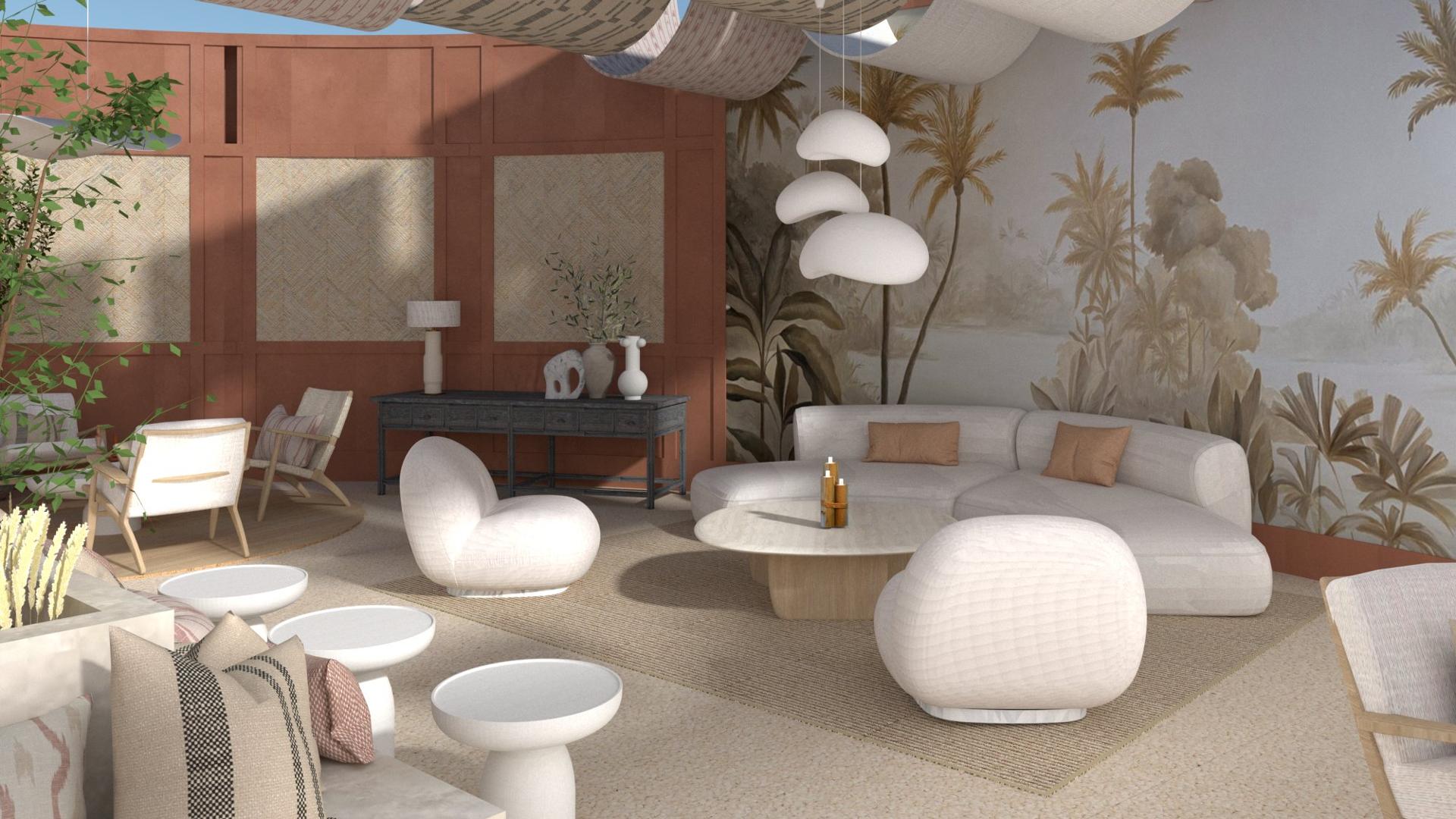
KASBAH
The studio is formed by Ane Devesa and José Agenjo, two friends and professionals who met at Casa Decor and, after years of individual careers, decided to join forces to present themselves at the 2020 edition. What began as a one-off collaboration led to the opening of their showroom located at Guzmán el Bueno 23, where we can also enjoy their kitchen furniture brand, TERRA Cocinas.
In their most recent participation at Casa Decor, TERRA moved audiences with its return to the origins: a functional, but above all welcoming kitchen, which has given rise to the anniversary hall at ARCO, transferring those values to this spacious lounge transformed into a refuge.
As is customary, a Mediterranean spirit permeates every corner: noble materials, textiles, and special attention to ceramics, their signature material. Craftsmanship is combined with contemporary design, functionality with poetry. Presiding over the space is an oil-painted mural created by the studio for the third collection edited by CR Class—an evocative landscape that opens a window in this oasis and invites us to enjoy the surroundings.
In KASBAH, every area can be felt as home. A space open to conversation, but also invites reflection and calm.
SALA A VERY WELCOMING LOUNGE (AVWL)
By the Government of Castilla-La Mancha
“Tránsitos. De la tierra al arte” is a project by the Government of Castilla-La Mancha in which artistic practice explores the transitions between craftsmanship and contemporary art, between thought and materiality.
This first edition focuses on the act of weaving, using warp and weft as a creative process to present three co-authored projects. Each of them has been developed by an artisan from the Legado Artesano brand of Castilla-La Mancha together with an artist from the national art scene.
Ramón Cobo, a specialist in wool treatment, and contemporary artist Irene Infantes create an inhabitable piece in which tradition merges with a contemporary language to tell a story of recovery and resilience in the preservation of the craft.
Juan Manuel Marcilla, an expert in wicker and other natural fibers, together with artist and gastronome Carles Tarrassó, propose a poetic work that transports us to the interior of the territory of Castilla-La Mancha and to the water currents that traverse it, hidden beneath our feet.
Master weaver Sergio Rosa and visual artist Maya Pita-Romero present a work in which the organic and the fluid intertwine with traditional textiles, forming an ecosystem that seems alive and invites us to reflect on intimacy, care, and the body itself.
This project, curated by Joaquín Ruiz Espinosa, is exhibited in the AVWL hall, designed by Fernando Sánchez using works by artisans of Castilla-La Mancha. Both have worked to create a space in which the pieces coexist under a calm, subdued light, conceived from the warmth of the earth’s interior.
SALA FUNDACIÓN ARCO
By SO Arquitectura
SO Arquitectura and its contemporary cloister: a sensory refuge at ARCO
At the heart of ARCO, SO Arquitectura delivers a quiet and precise intervention: the Fundación Room transformed into a contemporary cloister. The choice is deliberate. In the Middle Ages, cloisters were spaces for contemplation, dialogue and reflection on what truly matters. Here, that spirit is reimagined as a sanctuary where slowing down becomes an essential tool. The studio’s philosophy, “Creating a lifestyle at a slower pace”, finds its fullest expression in this space.
FOOD COURT
By iSiMAR
iSiMAR, with over 60 years of experience, specializes in designer furniture made from recycled and durable materials, conceived for outdoor and professional use. This year, in dialogue with ARCO’s avant-garde aesthetic, we present our pieces in their most essential state, without color, showcasing our singular material — metal — and highlighting our commitment to innovation, sustainability, and quality. Our collaboration with ARCO has been key in shaping unique spaces within the common areas, reflecting the fair’s contemporary and creative essence.
ARCOmadrid 2026 SPECIAL PUBLICATION
By Katya García-Antón and Margarida Mendes
The Word for the World is Water
In the context of ARCOmadrid 2026, and building on research into aquatic bodies developed through the curatorial sections of ARCOmadrid 2023, 2024, and 2025, Katya García-Antón and Margarida Mendes edit the publication The Word for the World is Water. World Building and Creative Resistance through Liquid Alliances. It brings together artists, writers, and scholars who think with water as a material, political, and relational force shaping planetary futures.
Water teaches that nothing exists in isolation: rivers, bogs, glaciers, wetlands, and seas carry histories of survival and violence, memory and resistance, care and extraction. To follow water is to move across scales — from the intimate to the planetary — and across worlds that precede and outlast us. At a time when waters are dammed, polluted, weaponized, sanctified, and reclaimed, this book proposes water as a guide for relational ethics and creative resistance. Drawing on Indigenous knowledges, feminist ecologies, decolonial thought, and artistic experimentation, it traces diverse water cosmologies and forms of territorial insurgency.
Authors Ailton Krenak, Susan Schuppli, Sara Ahmed, and Karolin Tampere write from the Amazonian basin, the icy rivers in Canada, the wetlands in Goa, and the Nordic–Baltic peatlands. The book includes artistic interventions by Himali Singh Soin and Karan Shrestha, and a poem by Nat Raha, that extend its inquiry through ritual scores, drawings, and poetry, engaging in glacial journeys, wetlands, and experimentations with language that moves along with tidal force and ecological turbulence
Together, these voices form a polyphonic hydrology — a chorus of aquatic thinking that insists water is not a metaphor, but kin, archive, witness, and a teacher. This volume affirms a shared conviction: that survival depends on learning how to be water — adaptive, relational, attentive, and enduring. Step into the waters ~
DESIGN OF THE OFFICIAL ARCOmadrid 2026 CATALOGUE
By Paco Lacasta
Intersecciones
ARCOmadrid 2026 rests on the concept of intersections: between the artist’s gaze and the world that provokes it; between galleries and those who treasure the works; between the fair and the pulse of its audience. In these intersections — spaces suspended between the physical and the imagined — thought, creation, and dreams take shape, dialogues are generated, and connections are woven that transcend the visible, giving rise to new experiences and meanings. Every work, every space, and every visitor participate in this web of relationships, making the fair a living ecosystem in constant motion.
In this way, the catalogue is conceived as an artefact woven from intersections. Its two sections organise the content in a way that mirrors, in miniature, the layout of the iconic Pavilions 7 and 9, guiding the gaze and experience of those exploring the fair, establishing a journey that is at once structured and free, rigorous and open to unexpected discoveries.
The galleries, the heart of the fair, pulse at the hinge-intersection that connects the two sections, orchestrating the flow of content and the visual narrative.
Throughout the publication, circles and squares — primordial geometric forms — intertwine as the thread of its graphic identity, organising and at the same time engaging with the content, the reader’s gaze, and the aesthetic experience of each page, transforming reading into an active, sensory, and reflective journey that mirrors the vitality of the fair itself.