




Contact

About Caducifolium
Laia Badia (Lleida, 2002) belongs to a new generation of designers deeply aware of today’s social and environmental challenges. While completing her studies at LCI Barcelona, she gained experience in various ateliers, where she began to question the global impact of the textile industry. From this reflection emerged Caducifolium, her most personal and daring project. The collection embodies the designer’s core values: sustainability, resilience, and adaptability, approached through a cross-disciplinary vision of design and culture as drivers of social transformation. Despite being developed with limited resources, the project has been showcased at the DHub, Barcelona Design Week, and now reaches the EGO runway at Mercedes-Benz Fashion Week Madrid.
Caducifolium at Mercedes-Benz Fashion Week Madrid
Collection lines
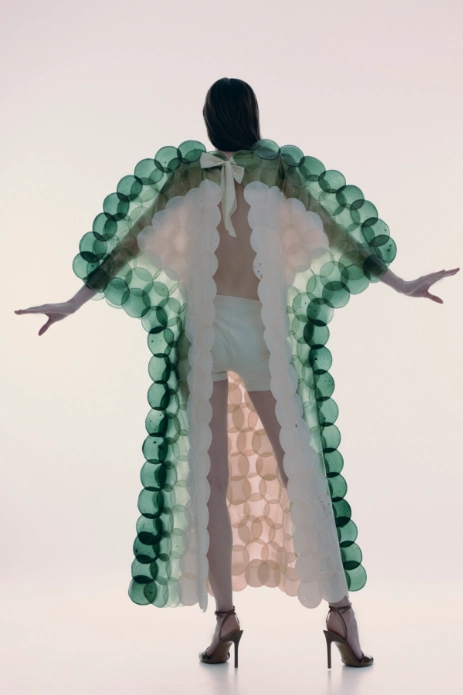
Without a planet, there is no future, no beauty, and no fashion. Caducifolium emerges from the urgency to rethink today’s production model, conceived as an uncomfortable question, a muted cry, and an S.O.S. call. Entirely made from biodegradable biomaterials, the collection proposes creating and discarding fashion without generating waste. Its circular modules can be re-melted into new pieces or returned to nature, turning the circle into a cyclical message that connects space, time, and nature.
Caducifolium lives and breathes. Like any living being, the garments change over time: their colors, structure, and strength are altered. The collection is born and ages, but it does not die; it reproduces into new forms or returns to the earth to nourish it. It is both ephemeral and immortal.
More than sustainable, the proposal becomes invisible to the natural environment thanks to its endless possibilities for transformation. This regenerative and modular fashion connects advances in material science with meticulous artisanal processes, bridging tradition and modernity. Each piece is accompanied by instructions to re-melt the modules and create a new biomaterial, blurring the boundaries between consumer and producer and returning fashion to its accessible origins, when anyone could manufacture at home.
The aesthetic inspiration draws from futurism, Catalan Gothic-stained glass, and an obsession with the circle, while its playful forms echo laughter as an act of resistance. In the face of a grey world slowly falling apart, Caducifolium proposes a sharp laugh from which to imagine new horizons.