




Contact
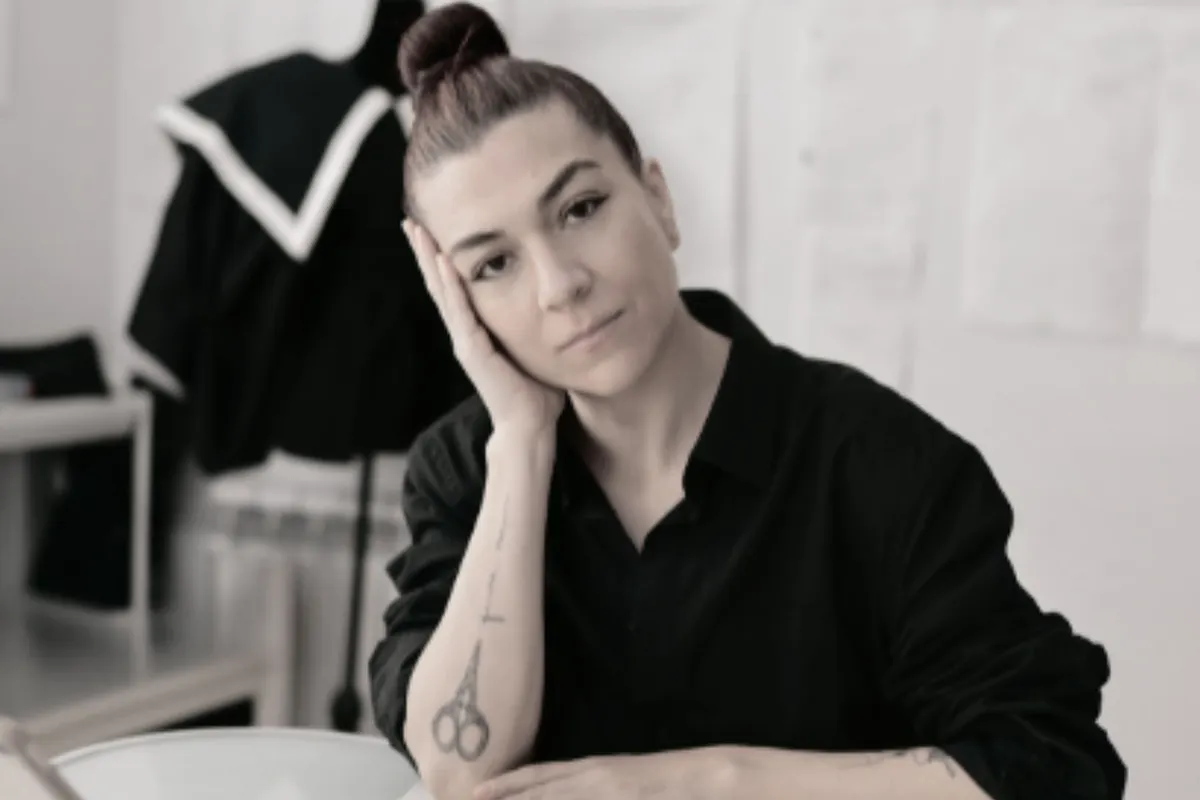
About Isabel is my name
Isabel Is My Name is an interdisciplinary research and creative studio founded in Spain by Isabel Peña (Chile) and Mauricio Quiñones (Argentina), whose practice uses the language of fashion to develop projects that engage with contemporary art, architecture, dance, and material culture.
Rather than producing collections, the studio conducts research in which clothing becomes a tool for reflecting on memory, the body, time, identity, and emotional relationships.
Each project begins with a question and evolves through processes of conceptual experimentation, material research, and narrative construction, understanding design as a space where thought and craftsmanship are inseparable.
Our practice lies at the intersection of the artifact and artifice; between technical precision and intuition; between academic research and the knowledge that emerges only after years of trial, error, and constant work.
Fashion is our language.
Research is our methodology.
Creation is our way of understanding the world.
A Shared Leadership Approach
The studio is led by Isabel Peña and Mauricio Quiñones, who have developed a collaborative leadership model in which creation, research, strategy, and production are all part of the same process.
While Isabel leads the aesthetic, material, and formal research for each project, Mauricio coordinates the conceptual research, narrative development, and strategic direction of the studio.
Rather than dividing roles, they build a single creative vision in which every decision answers the same question: How can design generate new ways of thinking about the human experience?
Three Creative Universes
Although all research projects are based on the same methodology, Isabel Is My Name carries out its work across three complementary universes.
Costume Art: This is the studio’s most experimental space.
Here, fashion functions as an artistic and performative language capable of bringing conceptual research to life through signature collections, installations, fashion shows, and exhibition projects.
Each collection constitutes an independent investigation in which clothing is no longer understood solely as a functional object but becomes a narrative device that engages in dialogue with contemporary art, architecture, philosophy, and dance. This is the territory where “Affective Conservation” is born.
Hybrid Prêt-à-Porter: Research can also be part of everyday life.
Our commercial line features timeless garments designed to accompany the wearer beyond the industry’s seasonal trends.
Each piece is developed through our Hybrid Upcycling System (HUS), a proprietary methodology that combines textile recovery, artisanal craftsmanship, and contemporary design to extend the life cycle of materials without sacrificing aesthetic innovation.
Here, sustainability is not viewed as a trend, but as a natural consequence of our design process.
Scenic Lab: The body in motion is another area of research for the studio. Scenic Lab develops projects for contemporary dance, theater, and music, viewing costumes as an active element within the dramaturgy of movement.
The pieces not only accompany the performer; they engage in a dialogue with them, alter their stage presence, and expand the body’s expressive possibilities.
Each project emerges from collaboration with companies, choreographers, and creators, exploring the relationship between space, movement, material, and emotion.
In our practice, we are inspired by art because it compels us to ask questions.
And by architecture because it teaches us to think about volume.
Dance, because it reminds us that the body is never still and is capable of emotion,
Craftsmanship, because it preserves the memory of the craft.
And fashion, because it has the extraordinary ability to bring all of this together on a single, emotional body.
We believe that design is not just about creating objects.
It is about creating meaning.
Collection lines
Emotional Preservation.
"We don’t preserve things.
We preserve the distance that separates us from who we once were."
There are garments that remain for years inside a box without ever touching a body again. They have ceased to serve their purpose, yet they continue to resist oblivion. It is not fabric that dwells in their folds, but memory. They are objects that survive because they contain something no material can name.
All preservation stems from a silent certainty: everything we love is destined to disappear.
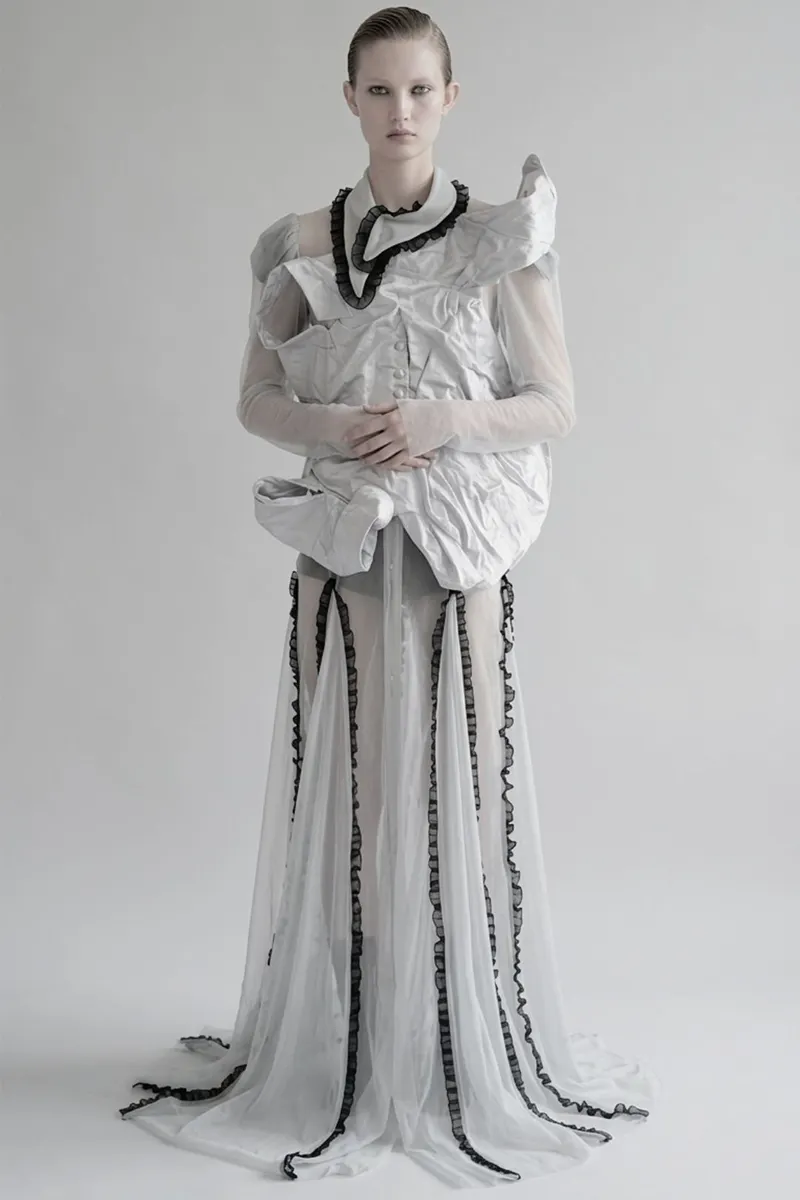
Emotional Preservation arises from that paradox. It transforms the dress into a place where affection attempts to make itself visible before fading away. Volumes contain, transparencies suspend, and reclaimed materials prolong the life of that which seemed to have run out of time. Each intervention is an attempt to preserve the irreplaceable.
But the collection does not speak of permanence.
It speaks of the gesture.
Of the deeply human impulse to continue keeping a garment even though it can no longer be worn. Of keeping an object because giving it up would mean accepting an absence. Of believing, even if only for an instant, that matter can sustain what time has already begun to erase.
Perhaps every collection is, at its core, a form of archive.
And perhaps every garment is the last place where a memory chooses to linger before it definitively becomes a recollection.
The collection is presented under the brand’s own system: HUS – Hybrid Upcycling System – An ongoing dialogue between garments and textiles from the past—recovered and restored through upcycling—and garments and textiles created from scratch. A meeting between the artisans of the past and the craftsmanship of today, revaluing processes, history, and narratives.