




Technological transformation in HVAC requires better-qualified professionals


Technological transformation is driving increased demand for better-qualified professionals in the thermal installations sector, particularly in disciplines such as renewable energy, energy efficiency, finance, sustainability and customer orientation, according to Manuel J. Ruiz, member of FEGECA’s Technical Commission.
Manuel J. Ruiz, member of the Technical Commission of FEGECA (Manufacturers of Heat Generators and Emitters), highlights the need for professional qualification in the thermal installations sector. “We have fully entered a technological transformation that combines the current energy transition with the arrival of digital transformation in thermal installations: monitoring equipment performance, connectivity and integration of heating and cooling generators, together with their regulation and control in each customised installation.”
This technological transformation is creating for the sector “strong demand for more professionals and better-qualified staff in disciplines such as renewable energy, energy efficiency, finance, sustainability and customer orientation.” This is confirmed by studies carried out, such as the one prepared by the Chair of Energy Sustainability at IEB-Universitat de Barcelona and Fundación Naturgy.
Demand for specialists
In addition to the already well-known problem of a lack of young people with the vocation to work in the energy sector, from generation stages through to consumption and thermal installation in the end user’s home, there is also a high average age and low qualification level among professionals, limited female representation, and changing skill profiles and qualifications. “Professionals with solid technical training in energy, electricity, mechanics and digitalisation are needed, as well as specialised installers, through vocational training that the Administration is promoting with new study plans and qualifications, together with initiatives from private applied vocational training centres.”
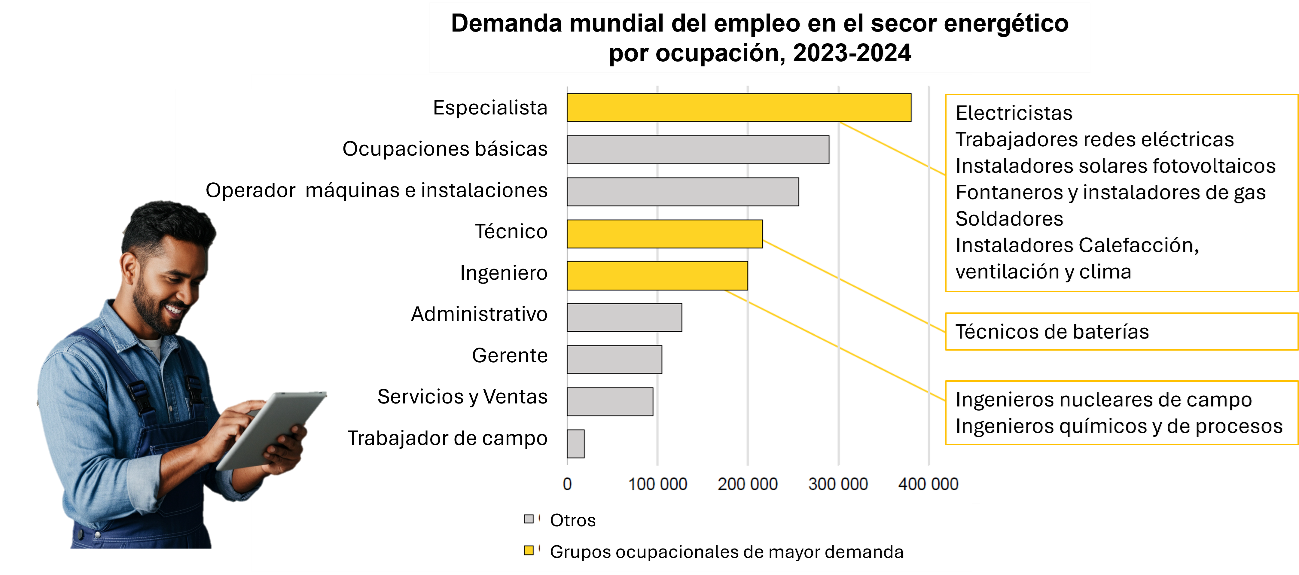
The International Energy Agency (IEA) study for 2025 on employability in the energy sector shows the workforce profile in the industry, highlighting increased professionalisation and a stronger specialist technician component. “It is on this profile that we must keep our focus, since it represents 50%, compared with 20% in other economic sectors.” In the same study, “the International Energy Agency reveals the six professions with the highest demand worldwide, which are also in high demand nationally and always within the specialist technician profile mentioned earlier: electricians, electrical grid workers, solar photovoltaic installers, plumbers and gas installers, welders, and heating, ventilation and air conditioning (HVAC) installers.”
Ruiz warns that “new combustible and renewable gases are arriving, such as biomethane, biopropane and hydrogen; new refrigerants for cooling cycles that do not create greenhouse effects; new approaches to the design and calculation of hot water storage systems and renewable energy capture in buildings: solar thermal, air source heat pumps, hybrid systems, photovoltaic solar energy systems... new materials in installation accessories, pipes, ducts and cabling...”
The role of the manufacturer
Manufacturers of heating or cooling generators, or electricity production systems for buildings, are becoming increasingly important in the qualification of the sector’s new professionals. “From the equipment design stage and its adaptation to new regulations, the manufacturer is the agent that develops and brings the latest technological advances to market for the end user. Inevitably, this also involves another key player: the specifier and installer of heating and cooling systems, who may be the same person or divided into different functions within the same company or across different firms.”
In Ruiz’s view, “this installer, who recommends, specifies, calculates and installs equipment, with qualifications or licences under the Thermal Installations Regulation (RITE), fluorinated gas handling certification, low-voltage electrical installation or data installation licences, etc., needs access to and training in the latest technologies in order to reduce installation and maintenance times, and must be able to recommend what best suits an increasingly demanding and better informed user: they need to work hand in hand with the manufacturer.”
In this regard, “close coordination between training in official educational centres, where recognised qualifications are obtained, and manufacturers is vital in order to address the shortage of professionals and their future qualifications. So, what can we do?”
Access to training
According to the International Energy Agency, the greatest barrier to accessing qualifications or training in the sector is the lack of awareness and ease of access to them, “which means there is still a great deal of work to do in promoting and facilitating training content and structures, more focused on current or potential professionals.”
In addition to promoting examples of good practice or success stories in the thermal installations sector, the expert points to actions in the following areas: “Promotion and information on studies leading to professional licences, and making administrative access procedures easier and simpler; ensuring generational renewal in companies, which, as this is a highly fragmented sector, would require measures aimed at small businesses; encouraging the entrepreneurial spirit of new workers entering the sector by reducing bureaucracy and barriers to entry, making it an attractive career path for those starting in the labour market; and linking the specialist technician role to digitalisation, which may motivate younger generations.”
For this task, “manufacturers also play their part by providing promotion and training focused on adapting to new regulations, incorporating new technologies, new equipment, new maintenance methods, and new ways of calculating and specifying systems, among others.” In short, “we are committed to improving the qualifications of professionals in thermal installations in the following directions: attracting new vocations and updating specialist technicians in new technologies.”