




Data is transforming the refrigeration sector


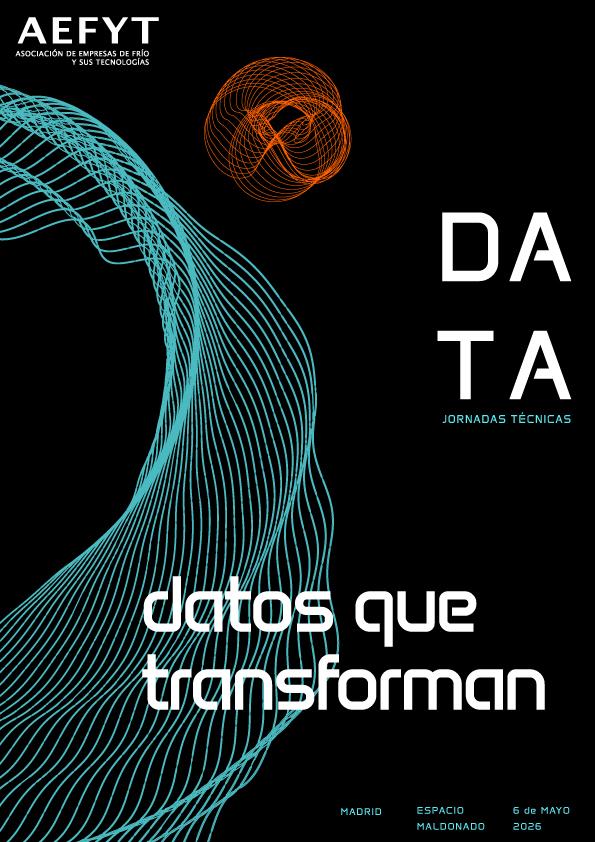
The refrigeration sector is undergoing a continuous process of evolution, as explained by AEFYT (the Spanish Association of Refrigeration Companies and Technologies) in the presentation of its technical conference Data, held in May. “Data must stop being abstract numbers and become part of strategy, helping us to assess risks, improve decision-making, prioritise investments, optimise maintenance and ensure operational performance.”
Continuous regulatory changes, technological developments and digitalisation are shaping a dynamic refrigeration sector that is, however, increasingly under pressure, AEFYT notes. “With more than 20,000 facilities still awaiting adaptation to European regulations and a fairly high forecast of new openings (more than 800 this year), the challenge is no longer purely technical.” If we add pressure on supply chains or labour shortages (with an estimated need for 9,794 technical profiles), the demands increase further.
In this context, operating blindly represents a risk. “It is no longer enough to react or simply comply; we are talking about anticipating, prioritising and streamlining operations.” Now, data “must stop being abstract numbers and become part of strategy, helping us to assess risks, improve decision-making, prioritise investments, optimise maintenance and ensure operational performance.” AEFYT’s holistic approach is key to this strategy.
The association notes that “we are a sector under strain, with set targets that are already beginning to cause both operational bottlenecks—due to a significant labour shortage—and increased pressure on the value chain”.
A clear example is the new €3 per tonne of CO₂ equivalent quota for obtaining allowances, which came into force in January this year. Its impact has already led to stockpiling strategies, with demand increasing by 30%, while 80% of sales are concentrated in just four gases.
Refrigerant shortages
This increase in demand brings the risk of refrigerant shortages and rising costs, which is encouraging the growth of a black market (in 2025, more than 101 tonnes of illegal fluorinated gases were seized, worth more than €4.5 million). “This pressure and these data require us, as a sector, to demand the responsible and safe use of refrigerants, because it is no longer only a matter of regulatory compliance; it is also a matter of business viability and safety.”
On the other hand, 2025 is ending with more than 18,000 Energy Saving Certificate (CAE) files. “A figure which, beyond efficiency, points to a faster return on investment and, as a result, increased pressure on the sector, adding to what has already been mentioned”.
In addition, continuous technological advances, especially driven by artificial intelligence, have multiplied the available data and, with it, the need to analyse and interpret it correctly. “We return to the need to anticipate in order to improve operational performance,” AEFYT points out.