



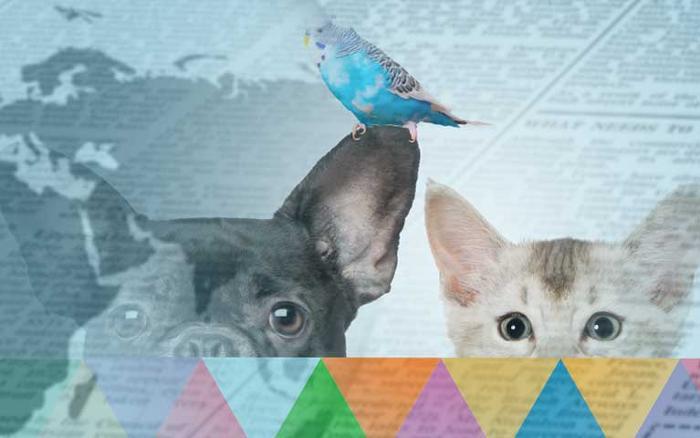
The silent revolution. Pets, inter-species bonding, and the new social change


In recent years, few social transformations have been as silent and yet as profound as the one affecting our relationship with pets. What for centuries was considered a domestic, private, and sentimental matter has become a phenomenon of public scope, with ethical, cultural, psychological, and social implications.

Almost half of Spanish households live with an animal, and eight out of ten citizens consider them members of the family. We are talking about a cultural change that is redefining how we understand family, coexistence, and, ultimately, society itself.
The human-animal bond, once relegated to the anecdotal, is emerging strongly as a social fact that challenges philosophy, law, and politics, but also the daily lives of millions of people.
This transformation is not sudden. It has deep roots that go back to the beginnings of domestication. Dogs and cats have accompanied humanity for thousands of years, although for a long time, the relationship was utilitarian. However, even in these functional uses, there was already an element of emotional attachment, which has intensified over the centuries.
Modern thinking, however, delayed this recognition. In the 17th century, René Descartes described animals as automatons, biological machines without consciousness or emotions. This view, which prevailed for centuries, served to justify instrumental treatment: if animals lacked subjective experience, there was no moral dilemma in exploiting them. Ethics was reserved for the human realm, and the boundary between “us” and “them” seemed insurmountable.
The Enlightenment began to crack that idea. Jeremy Bentham, a utilitarian philosopher, asked the question that would change the debate forever: “The question is not whether animals can reason or speak, but whether they can suffer.” With a stroke of his pen, he shifted the focus from reason and language to the ability to experience pain. If animals could suffer, then their interests had to be considered.
Empathy and justice could no longer be limited to the human species.
The 20th century consolidated this reflection. Peter Singer argued in Animal Liberation (1975) that animal suffering should count as much as human suffering in moral calculations. Tom Regan argued in The Case for Animal Rights (1983) that animals are subjects of life, with rights of their own, beyond their usefulness to humans. Martha Nussbaum, in the first decade of the 21st century, proposed a theory of justice that includes animals as beings with capacities that can flourish or be frustrated. Suddenly, the human-animal bond ceased to be a private matter and became a question of justice and public morality.
Science joined philosophy. In 2012, the Cambridge Declaration on Consciousness, signed by internationally renowned neuroscientists, affirmed that nonhuman animals possess states of consciousness and emotions. Their inability to express these in human language does not mean they do not have them. It was the scientific confirmation of what millions of people already sensed in their daily lives: that their animals feel, suffer, enjoy, and interact in complex ways.
Meanwhile, Spanish society was undergoing its own change. Today, 49% of households live with companion animals. And most importantly, eight out of ten citizens consider them part of the family. This recognition transcends the private sphere. It implies that animals participate in family dynamics, influence everyday decisions, and form part of our emotional and social networks. Language reflects this: we increasingly talk about “companions” or “family members” rather than “property.”
Surveys also show that citizens recognize emotions in animals that are comparable to those in humans: fear, joy, loyalty, empathy. Where a certain distance persists is in the recognition of their more abstract cognitive abilities. But even with this difference, social perception has changed irreversibly. The human-animal bond is now a mainstream cultural value.
This bond also has concrete and measurable consequences. Psychology has shown that companion animals can become attachment figures, providing security, comfort, and companionship. John Bowlby formulated attachment theory to explain how emotional bonds are essential to human development.
Today we know that this attachment can also extend to animals. For many people, living with a dog or cat provides the same kind of emotional security as close human relationships.
In physiological terms, interacting with animals reduces levels of cortisol, the stress hormone, and increases oxytocin, which is linked to well-being and trust. Various studies have shown that living with animals reduces anxiety and depression, increases resilience in situations of grief, and promotes daily physical activity. In other words, animals tangibly improve our mental and physical health.
We know that, in childhood, living with animals translates into greater empathy and responsibility. School programs that integrate interaction with dogs have shown improvements in children's self-esteem and socialization skills. In some cases, assisted reading programs have been implemented, where children read aloud to a dog, reducing anxiety and boosting confidence. Far from being anecdotal, these programs have shown measurable results in school performance.
In addition, in old age, animals help combat unwanted loneliness, a growing problem in Spain. Older people who live with animals report higher levels of life satisfaction and fewer feelings of isolation. In these cases, the bond becomes a factor in well-being, but also a space where institutional shortcomings are evident.
The human-animal bond also appears in contexts of social vulnerability. Many homeless people live with animals that represent their only emotional support network. For them, a dog is companionship, security, and dignity. However, temporary housing resources often prohibit access with animals, perpetuating exclusion. Choosing between a roof over one's head and a vital companion is an unacceptable dilemma that shows the extent to which our policies have not yet incorporated this bond into their design.
It is estimated that more than half of women who live with animals have delayed the decision to leave a violent home for fear of leaving them behind. Abusers use animals as an instrument of control, aware of the emotional bond that ties them to their victims. Here, the human-animal bond is not a secondary detail, but a factor that conditions vital decisions. Including animals in comprehensive protection protocols is not a sentimental gesture, but a safety measure for the victim.
These examples clearly show that the human-animal bond is not a minor issue. It is present in public health, education, gender equality, housing, and social cohesion. It reflects collective values and priorities. A society that recognizes and protects this bond is a society that cares for the most vulnerable, both human and non-human.
The Spanish legal framework has begun to take steps in this direction. The 2021 reform of the Civil Code recognized animals as sentient beings. This paradigm shift is not minor, but reflects a profound cultural change that is being translated into law. The Animal Welfare Law has also provided us with some examples that go beyond animal rights, such as rulings that begin to recognize labor rights to assist with fundamental and unavoidable obligations regarding the keeping of companion animals, or new approaches to issues of public transportation and emergency protocols.
At this point, the question is inevitable: how can social and legal recognition be transformed into real policies that protect and develop the human-animal bond? The answer lies in ceasing to treat them as minor policies and beginning to design them as authentic and inclusive public policies. This implies stable funding, mandatory training for professionals, the creation of multidisciplinary teams, and clear evaluation indicators. It also means integrating the bond into all areas: health, education, housing, social services, and public safety.
This is not a utopian program. There are measures that can be implemented immediately. Support programs for the elderly that guarantee the continuity of the bond in situations of dependency. Protocols on gender violence that include animals in shelter resources. Social housing that does not exclude those who live with animals. Schools that incorporate empathy towards animals into their curriculum or health centers that recognize their therapeutic value. There is much to be done.
These actions are not only for the benefit of animals. They are measures that improve mental health, social cohesion, and justice. Protecting the human-animal bond is protecting an essential aspect of community life.
The human-animal bond is a mirror of society. It shows the extent to which we are capable of recognizing vulnerability, practicing empathy, and building communities based on mutual care. Treating it as a secondary issue is to waste an unparalleled opportunity for transformation, because caring for the animals we live with is, at the same time, caring for ourselves as a society.
Author: Ruth Manzanares, Specialist in public policies for animal protection. Researcher in inter-species relations.