




Museums, supermarkets and airlines are making moves to join the new pet-friendly culture


The pet-friendly culture is becoming widespread throughout Europe, with museums, supermarkets, and airlines, among others, joining this trend.
Europe is adapting to a social reality that is here to stay: millions of people live with pets and are not willing to give up that bond in their cultural and daily lives.
In recent months, pioneering initiatives have emerged in diverse fields such as museums, shopping centers, and airlines, devising ingenious and imaginative solutions to allow the inclusion of pets in their facilities and thus promote responsible coexistence and the well-being of people and animals in a new, more sustainable and inclusive society
The Italian reference, accessible culture without leaving your dog
In Italy, projects like the “Dog & Museum Road Show,” promoted by Bauadvisor, offer a practical alternative until April 2026: free dog sitting services at 15 tourist and cultural centers across the country, booked in advance via website or app. The goal is clear: to make it easier for owners to access exhibitions and heritage sites without leaving their dog alone at home or missing out on the cultural experience
As Dino Gasperini, director of Bauadvisor, explained to The Times, the initiative responds to a clear reality: “Half of dog owners today forgo cultural activities because they do not want to leave their pets at home.”
The context explains everything: Italy has 8.8 million dogs, one of the highest canine populations in the European Union, second only to Germany and followed by Spain. Culture, like so many other sectors, cannot ignore this growing reality.
The Spanish case. The National Museum of Natural Sciences consolidates and normalizes its commitment to animal inclusion.
In a pioneering initiative in Spain, in 2024, the National Museum of Natural Sciences (MNCN-CSIC) opened its doors to dogs. After an initial pilot test, limited to one day a week and during off-peak hours, the result was revealing.
- No incidents.
- Positive atmosphere.
- Especially favorable reactions from children.
- Completely normal.
Today, the museum is officially dog-friendly, allowing dogs accompanied by their owners every day it is open, making it one of the first natural history museums in the world to adopt this policy and, as far as we know, the only national museum in Spain to do so.
Experience shows that, with good judgment, commitment, and responsibility, coexistence is possible.
The German case. Supermarkets that consider pets and their owners, creating a new customer experience.
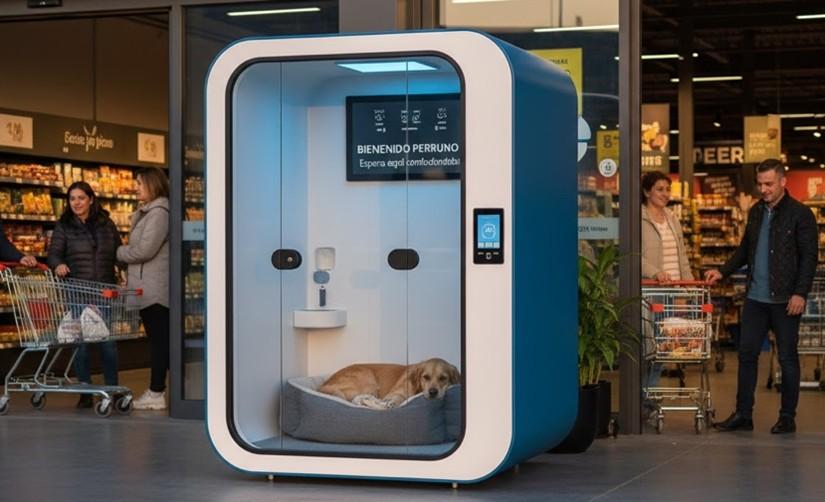
In German cities like Hamburg and Berlin, some supermarket chains are installing smart dog parking pads, a new type of service designed for those who shop with their dogs. These pads are located:
- Climate-controlled and ventilated;
- With transparent panels so the pet can see outside;
- Controlled by a mobile app or digital code, ensuring only the owner can access;
- Designed so the dog can wait comfortably while its owner shops.
The idea is to eliminate the risks associated with leaving dogs tied up outside or inside cars, and to transform retail into a safer and more pet-friendly environment. This type of solution demonstrates how brick-and-mortar stores are responding to the reality that a high percentage of urban households have pets and that their daily routines (such as grocery shopping) are dictated by that bond.
Flying with pets is gaining ground in Europe. From the warehouse to the cabin.
The airline sector is also evolving: many European airlines have relaxed their policies to allow dogs and cats to travel in the cabin with their owners, provided they meet certain conditions in each case.
Iberia, Vueling, Lufthansa, Air France, and Eurowings, among others, have developed policies allowing dogs and cats to travel in the cabin with their owners. While the conditions vary, they typically include weight and size limits, advance booking, and a maximum number of animals per flight
To avoid problems, it is essential to check updated requirements before buying your ticket, such as permitted sizes, documentation, fees, and route restrictions
From exclusion to integration.
These initiatives show how different sectors are recognizing the importance of companion animals in the daily lives of people who are no longer willing to choose between their activities and their pets.
The design of services oriented towards responsible coexistence, clear protocols and staff training, and communication to the public and users of rules with professional criteria
This new reality presents a strategic opportunity for sectors that want to connect with broad and diverse audiences, without compromising animal welfare or the quality of their services