




CAE incentive schemes will encourage replacement of boilers with heat pumps


The Ministry for Ecological Transition and the Demographic Challenge (MITECO) has proposed applying multiplier factors to Energy Saving Certificates (CAEs) to encourage the replacement of boilers with hydronic heat pumps. The proposed coefficients of two, three and four, which will be applied in the formulas for calculating savings, plus an additional factor for severely vulnerable households, may significantly increase the financial incentives by partially offsetting the tax penalty imposed on electric air conditioning. This was the opinion of Héctor Acebes, from the consultancy firm Balantia, at the 6th Heat Pump Forum. AFEC, for its part, highlighted the urgency of approving these multipliers before the end of the year.
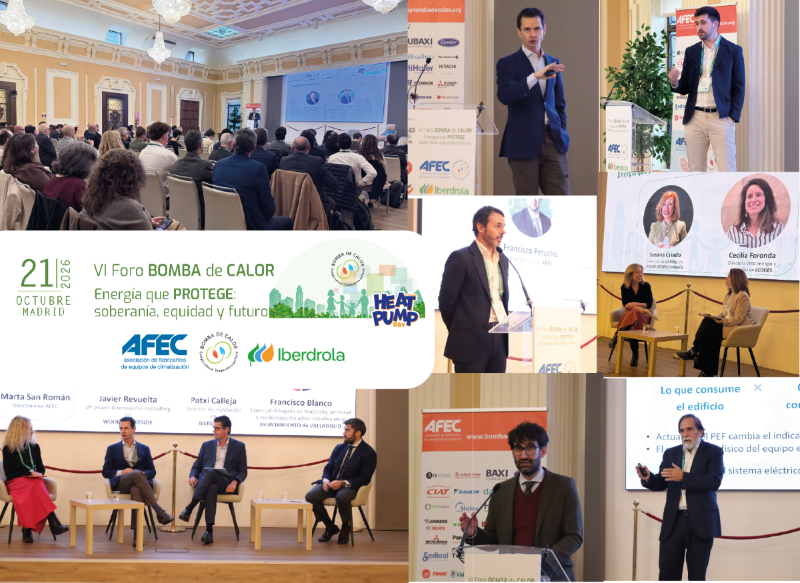
Héctor Acebes presented the multipliers for the Energy Saving Certificates (CAEs) designed to encourage the replacement of boilers with hydronic heat pumps, during his speech at the 6th Heat Pump Forum, organised by the Association of Air Conditioning Equipment Manufacturers (AFEC) and Iberdrola, which was held recently in Madrid. The meeting focused on a number of key issues facing the sector, such as reducing dependence on foreign energy, protecting homes from the cold and heat, and preparing buildings and cities for the coming decades. The discussion therefore covered topics such as the energy, economic, environmental and social benefits of heat pumps, and the instruments required to expand their uptake.
At the opening, Francisco Perucho, president of AFEC, highlighted the industry’s progress since the launch of the Heat Pump Promotion Plan in 2016 and manufacturers’ ability to drive forward the electrification of air conditioning. “We need support and certainty. Clear legislation and a defined direction are essential,” he said, while also advocating for new funding models. For his part, Víctor Carballo, head of Smart Clima at Iberdrola, emphasised the importance of facilitating the refurbishment and replacement of fossil fuels: “This transition requires a coordinated effort by all stakeholders in the sector to fully realise the benefits of this technology.”
Opportunities offered by electrification
Javier Revuelta, Vice-President of Power & Renewable Consulting at Wood Mackenzie, analysed Europe’s dependence on imported gas, price volatility and the opportunities offered by the thermal electrification to reduce exposure to international markets, by capitalising on an increasingly renewable electricity generation mix. And Samuel Pérez, a senior expert at Iberdrola, presented the updated AFEC report on energy efficiency and emissions from domestic heating and domestic hot water systems. The results confirm that, in the scenarios analysed, heat pumps provide at least three or four times as much useful heat per unit of primary energy as the combustion systems under consideration.
The proposed update to the electricity primary energy conversion factor (PEF) is a major step forward. The proposal will enable the energy certification of buildings to better reflect the transformation of the energy system. AFEC believes that the new PEF must be approved as a matter of urgency in order to send the right signal regarding both the construction of new homes and refurbishments.
Susana Criado, presenter of the Capital programme on Radio Intereconomía, interviewed Cecilia Foronda, director of the Energy and People Division at ECODES, about energy poverty, which affects protection against both the cold and extreme heat. Criado highlighted the scale of energy poverty in Spain, particularly during the summer months, and the financial difficulties that prevent many families from accessing efficient air conditioning. She also questioned the effectiveness of the support schemes, the way the social electricity tariff works, and the feasibility of electrifying rented properties.
Foronda highlighted the barriers faced by vulnerable households in meeting the initial investment and accessing grants that require them to pay money up front and navigate complex administrative procedures. She called for greater technical and administrative support, funding and equipment leasing schemes, phased refurbishment, and better tailoring of support measures to families’ circumstances. The pair also discussed the importance of educating users to ensure that the efficiency of the facilities translates into real savings and well-being.
Adapting to new consumption patterns
The closing panel, moderated by Marta San Román, Director General of AFEC, brought together Javier Revuelta; Patxi Calleja, Head of Regulation at Iberdrola; and Francisco Blanco, Councillor for Finance at Valladolid City Council, to analyse the future of thermal electrification from three perspectives: climate, city and building. Calleja argued that it was necessary to adapt the electricity grids to new consumption patterns and to address the tax and regulatory disparities between electricity and natural gas, which penalise electrification and prevent the full benefits of energy efficiency from being passed on to consumers. For his part, Blanco presented Valladolid’s tax initiative for 2027, which provides for a 50% reduction in property tax (IBI) for four years and a 95% reduction in construction tax (ICIO) for air source thermal and geothermal installations, subject to the established requirements. The proposal, which is still under consideration, aims to reduce energy consumption, improve the city’s environmental quality and boost local economic activity.
The initiative comes under the new legislation introduced in 2026, which allows existing municipal tax relief for photovoltaic self-consumption to be extended to thermal self-consumption through air source thermal energy. Following Valladolid’s lead, other local councils, such as Pozuelo, Seville, Ciudad Real, Fuenlabrada and Humanes, have also announced their intention to include property tax (IBI) and construction tax (ICIO) relief in the tax by-laws they are drafting for 2027.
The event concluded with an address by Víctor Marcos Morell, Director-General for Energy Planning and Coordination at MITECO, who expressed the Ministry’s support for electrification and highlighted its contribution to energy self-sufficiency and decarbonisation.
The 6th Forum highlighted that heat pumps can safeguard the economy, people’s well-being and the future of buildings and cities. Its expansion requires coherent regulation, accessible funding, high-quality facilities and measures to ensure that its benefits reach users.