




AFEC and AEDICI highlight the role of engineering in developing efficient systems


José María Zarzuela, President of AEDICI, emphasised the role of engineering and consultancy in the development of efficient systems during a conference organised by AFEC on the strategic role of regulation and control in non-residential buildings. Marta San Román, General Director of AFEC, highlighted that a building’s real performance depends on multiple factors, ranging from design to operation, including installation, commissioning and maintenance.
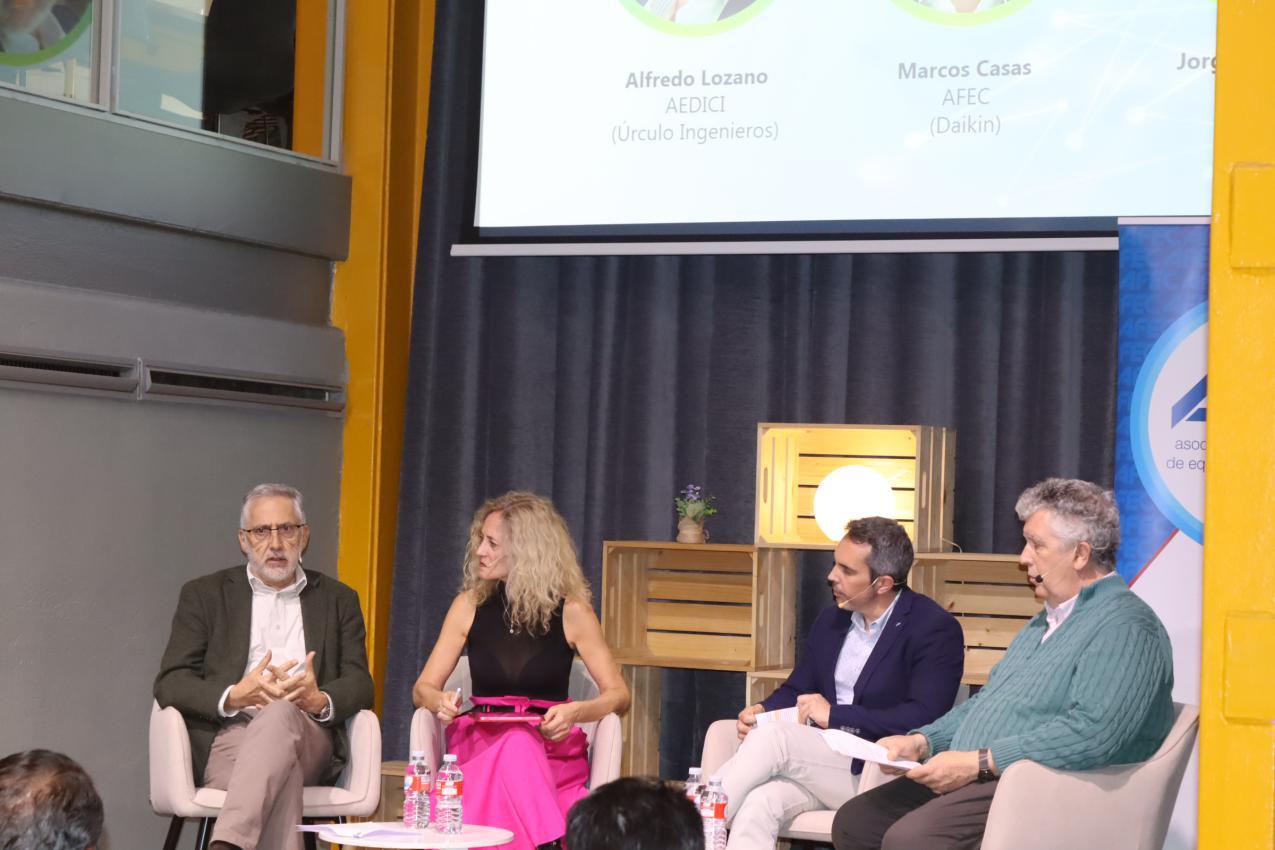
The President of the Spanish Association of Engineering and Consulting Firms for Building Services (AEDICI) emphasised the role of engineering and consultancy in the development of efficient systems, while the General Director of the Association of Air Conditioning Equipment Manufacturers (AFEC) stressed that a building’s real performance depends on multiple factors ranging from design to operation, including installation, commissioning, and maintenance. In this context, Marta San Román explained the creation of AFEC’s cross-sector working group on Regulation and Control, involving engineering firms, equipment manufacturers and component specialists, with the aim of generating a shared technical vision aligned with real project conditions.
The conference, held at the Official Association of Industrial Engineers of Madrid (COIIM), focused on the Technical Recommendations on Regulation and Control in Non-Residential Buildings, a document providing structured criteria for integrating regulation and control (R+C) across all phases of thermal installations.
Javier Ara, President of the Infrastructure, Building and Urban Planning Commission of COIIM, underlined the importance of engineering as a regulated profession, encouraging new engineers to join professional associations, and highlighting its contribution in areas such as regulation and control. For his part, José María Zarzuela, President of AEDICI, framed the discussion around a real case in which a recently completed installation was not achieving the expected performance due to insufficient definition of regulation and control, highlighting the role of engineering and consultancy in developing effective systems.
Clear criteria
According to San Román, the document presented is intended as a tool to structure a highly complex and constantly evolving technical field, providing clear criteria without prescribing closed solutions. Its structure covers the role of control across different parts of the installation, as well as aspects such as system types, networks, protocols, technical requirements, operating manuals, sustainability and the regulatory framework. As a complement, AFEC previously developed an infographic that provides an initial approach for building owners and serves as a starting point for a more detailed analysis with technical teams.
During the round table discussion, three of the authors of the guide took part: Alfredo Lozano, representing AEDICI, and Marcos Casas and Jorge Giménez, on behalf of AFEC. The discussion addressed various key aspects of regulation and control from a technical and applied perspective.
Alfredo Lozano explained how control design determines the behaviour of an installation throughout its entire lifecycle, structuring the approach into four phases: sizing, automation, technical management, and operation and maintenance. He highlighted the importance of correctly defining control sequences, operating logic and system coordination, as well as the need to align expectations with the client from the early stages. He also stressed the role of tools that enable proper technical and economic assessment, and the usefulness of carrying out audits over time to evaluate the actual performance of installations.
From the perspective of systems and technology, Marcos Casas focused on the evolution of management capabilities, with increasingly powerful control systems and massive availability of real-time data. He underlined the importance of data quality and continuous monitoring as the basis for effective control, as well as the potential of digital tools and artificial intelligence for analysis and system optimisation. He also pointed out the importance of system monitoring being carried out by those who participated in its design, as they have full knowledge of its conceptual design and execution.
Jorge Giménez addressed regulation and control from the perspective of field devices, highlighting the role of valves, actuators and sensors in the physical behaviour of the system. He explained how control is structured through feedback loops that compare expected performance with real behaviour, and how parameters such as valve authority or response time directly influence system stability and accuracy. He emphasised the importance of correct hydraulic installation and balancing, now supported by the technological evolution of the components themselves.
Verification and commissioning
In the section dedicated to commissioning and operation, the speakers agreed on the importance of translating the design into real conditions through rigorous verification of sequences and proper system adjustment. The value of having clear and detailed reference documentation was highlighted, as well as the need for continuous monitoring to maintain performance over time. Operation was identified as the stage in which control translates into efficiency, comfort and sustainability, supported by data quality and coherence between design, installation and operation.
During the discussion, several issues were addressed, such as the difficulty of incorporating audits into projects from an economic perspective, the tendency to postpone control to the final stages of execution, which in restrictive budget scenarios leads to simplified or reduced control scope, and the balance between the level of control and the real needs of the installation. Other topics included the evolution of protocols towards higher levels of interoperability and the impact of the Energy Performance of Buildings Directive (EPBD), which strengthens the role of regulation and control in performance verification and in the integration of aspects such as indoor environmental quality.