




Marta San Román (AFEC): Filtration plays a key role in ensuring indoor air quality


Marta San Román, Director of the Association of Air Conditioning Equipment Manufacturers (AFEC), states that filtration complements ventilation and plays a vital role in ensuring indoor air quality and contributing to the environmental health, well-being and comfort of the people who occupy buildings.
“Effective filtration improves indoor air quality, ensures that HVAC systems operate efficiently, and helps us move towards more efficient, healthier and more sustainable buildings.”
The Director of AFEC explains that “filtration complements ventilation and plays a vital role in ensuring indoor air quality and contributing to the environmental health, well-being and comfort of the people who use the buildings”. “Every space has its own – and ever-changing – requirements; that is why it is so important to select, design, install and maintain filtration systems, taking into account the building’s use, the pollutants present and the actual operating conditions”.
Marta San Román also stated that “at AFEC, we want filtration to be given the importance it deserves in the design and management of facilities, right from the start, from the very outset of the project”. According to this expert, “correct filtration improves indoor air quality, helps air-conditioning systems to function effectively and contributes to the development of more efficient, healthier and sustainable buildings”. In this regard, “for us, promoting this technical expertise and sharing it with the industry is a direct way of adding value and continuing to work towards better indoor environments”.
Filtration masterclass
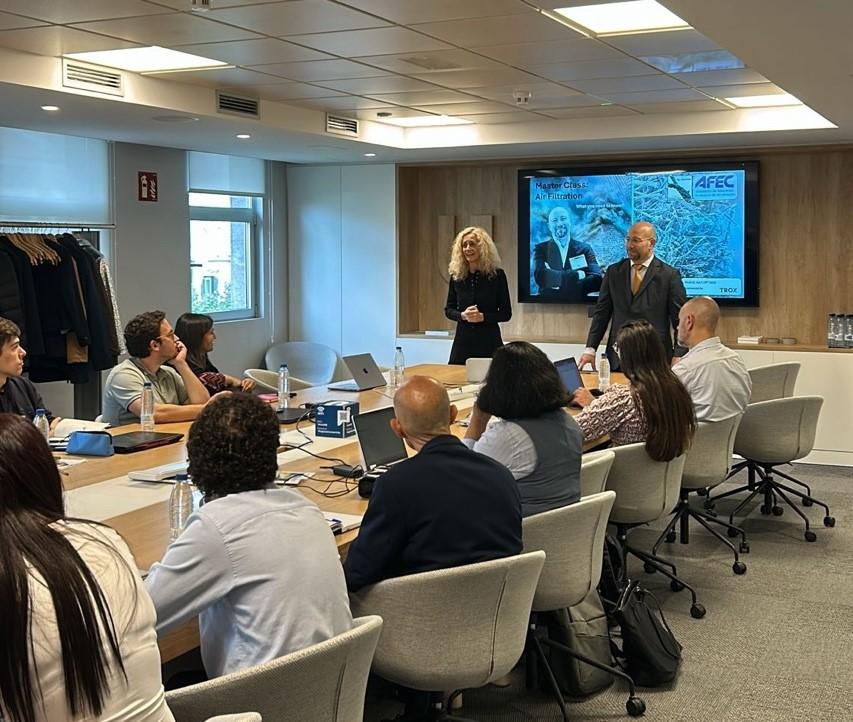
AFEC recently held the second edition of its technical masterclass initiative, featuring a session on air filtration led by Dr Iyad Al-Attar, an international authority on filtration and indoor air quality. With 28 years’ experience in this field, this expert promotes, through his technical and outreach work, a comprehensive approach to air quality management and the integration of air quality monitoring from the earliest stages of urban planning and building design.
The masterclass focused on the role of filtration as a key factor in ensuring good indoor air quality – an ‘invisible’ factor whose importance is not always fully recognised, as its effects are neither tangible nor immediately apparent. In many cases, this situation can lead to investment decisions being limited to mere regulatory compliance, without taking into account key factors essential for the proper design of filtration systems, such as the nature of the particles and contaminants to be captured, the operating conditions of the facility, or the need for proper maintenance to ensure their long-term effectiveness.
Throughout the day, Dr Al-Attar combined scientific principles with practical applications, covering both the fundamentals of air filtration and its main applications in buildings and HVAC systems. The sessions provided an opportunity to analyse filtration mechanisms, the behaviour of pollutants present in indoor air – including particulates and gaseous compounds – and the factors that influence the real performance of the systems, such as environmental conditions, the building’s location, its intended use and the quality of the installation.
Adapted to each space
One of the key points was the need to design filtration systems that are fit for purpose, i.e. tailored to the specific purpose, characteristics and real requirements of each space. In this regard, it was emphasised that selecting the right filter does not mean oversizing or overspecifying the solution, but rather choosing the most suitable option for each application, striking a balance between air quality, energy efficiency, purchase cost, operational impact and maintenance requirements. Therefore, in addition to initial efficiency, it is essential to assess their actual performance in service, the development of pressure drop, the stability of the filter media, operating conditions, ease of maintenance and the associated costs throughout their service life.
The conference also included a review of the main international standards governing filter performance and guiding their correct selection, as well as a discussion on the relationship between filtration, sustainability and energy efficiency. This approach is becoming increasingly important in a context where indoor air quality is a growing concern in hospitals, commercial buildings, industrial settings and public spaces.
The masterclass also highlighted the current challenges facing HVAC systems, particularly in the face of extreme weather conditions, and how these factors can affect both the operation of the systems and the well-being of the occupants. This approach made it possible to link filtration to real-world challenges relating to building operation, maintenance, efficiency and health.