




HVAC market consolidation in 2026 following 11.4% growth in 2025


2026 is shaping up to be a year of consolidation for the Spanish HVAC market, according to the Annual Market and Sector Situation Report from AFEC. The thermal installation and climate control sector is gaining increasing weight within Spain's socio-economic landscape, indicating that the aerothermal/heat pump, climate control and ventilation market grew by 11.4% in 2025.
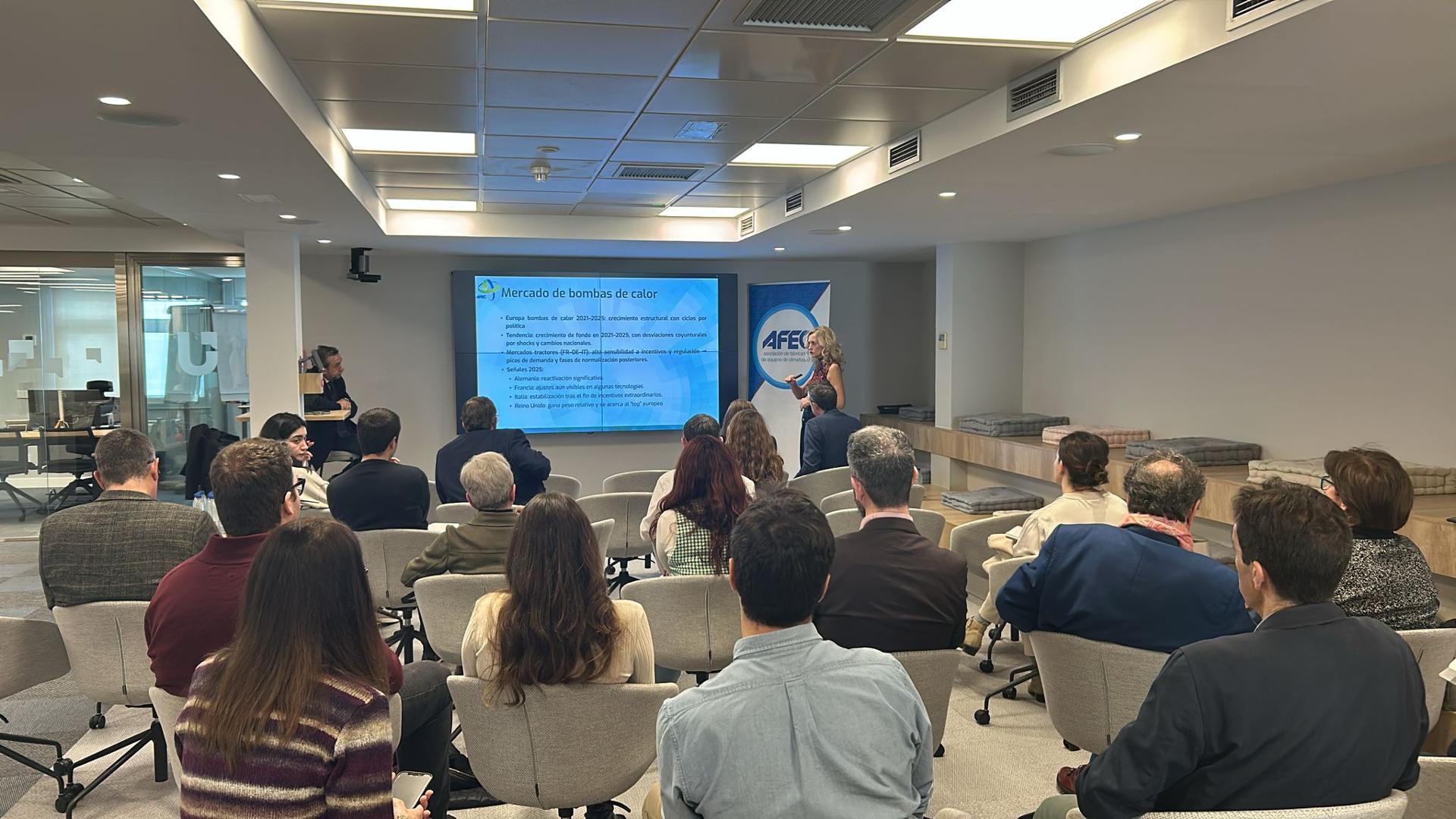
The report was presented at the headquarters of the Spanish Association for Standardisation (UNE) by AFEC President Francisco Perucho, Luis Mena (Statistics Committee) and General Manager Marta San Román. Together, they reviewed the AFEC market report, which compiles aggregated data on heating, cooling and DHW equipment, air distribution and diffusion systems, ventilation units, residential ventilation and Air Handling Units (AHUs).
The 2025 fiscal year confirmed real growth in the Spanish HVAC market. This progress is supported by factors such as price, volume and a more professionalised mix across the residential, commercial, tertiary and industrial segments. Electrification is gaining a structural presence in both supply and demand, although its pace remains conditioned by "economic signals" related to OPEX and energy taxation.
Macroeconomic Environment
The macroeconomic environment in Spain has been moderately favourable, with GDP growth above the European average and a dynamic labour market, despite signs of slowing in some sectors. Monetary policy has entered a stabilisation phase, reducing financial pressure but not eliminating uncertainty.
The energy market remains a determining factor. The relationship between electricity and gas prices, along with tax structures, directly influences the competitiveness of heat pumps against fossil fuel solutions. The trend towards increased renewable penetration in electricity generation reinforces the coherence of electrification, but the economic signal to the user depends on fiscal and regulatory design.
Geopolitical volatility requires caution in purchasing and risk management. Tariffs and trade defence instruments affect the supply chain without altering its structural functioning.
In construction, the market is showing mixed signals. The new tertiary construction is losing momentum; while retrofitting and asset repositioning are gaining weight. Ventilation and IAQ continue to be underrepresented in certain refurbishment projects, despite their direct impact on health, comfort and efficiency.
Digitalisation is advancing as an operational necessity rather than an accessory. Regulation and control, interoperability and operational verification have consolidated as requirements for converting installed power into real performance. The market is beginning to value measured performance and real consumption reduction, rather than just technical specifications.
Growth and Equipment Segments
The aggregate growth of 11.4% in 2025 is accompanied by a shift from a focus on equipment to a focus on integration, operation, and data.
Air conditioning, heat pumps, and hot water equipment grew by 6.5% in 2025 after a 2024 adjustment, consolidating a trend marked by the increasing acceptance of aerothermal and geothermal energy as indispensable solutions. Growth was consistent across residential, commercial and industrial segments.
Air Treatment Units (ATUs) and heat recovery ventilation remained flat with 0.9% value growth, as did the air diffusion and distribution equipment market. However, residential and industrial ventilation showed significant growth due to regulatory factors, the demand from data centres, and industrial operational requirements.
Regulation and Financing
In terms of regulation and control, European legislation is driving towards digitalised buildings, but the actual adoption of advanced control systems (BACS) remains uneven. The gap between regulatory requirements, technological potential and construction practice will determine energy, environmental and operational performance in the coming years, as well as the evolution of the BACS market.
Financing plays a major role in the transition. Energy Saving Certificate (CAE) mechanisms show scalability potential in industry and the tertiary sector, while European programs highlight the need to balance quality control, accessibility and administrative agility to maintain legitimacy.
Sector Outlook and Perspectives
According to the report, 2025 reflects a market with structural momentum, although subject to tensions that require consistency between regulation, economic signals and technical implementation. The difference between solid growth and fragile growth lies in closing gaps in talent, coordination and fiscal design.
Finally, 2026 is shaping up to be a year of consolidation. The thermal installation and climate control sector is gaining increasing weight within Spain's socio-economic landscape. HVAC, BACS and IAQ solutions are strategic infrastructure underpinning economic activity, essential services and energy security in an increasingly demanding geopolitical, social, climatic and economic environment.