




Josep Saumell (Mossos d’Esquadra): Trade fairs provide the greatest opportunity for interaction between the private and the public sectors


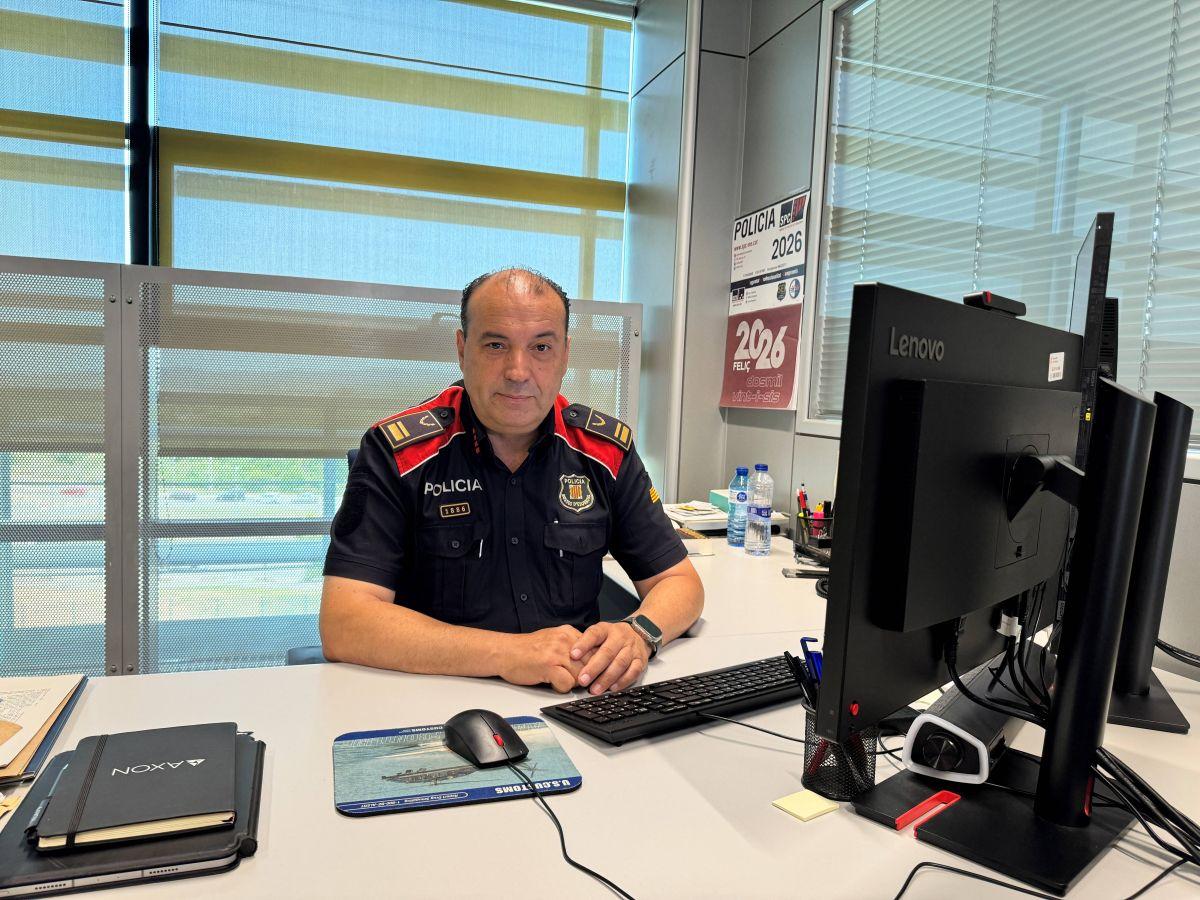
Commissioner Josep Saumell, Deputy Head of the Senior Technical Police Headquarters of the Generalitat’s Police Force – Mossos d’Esquadra (PG-ME), explains in the following interview his main objectives for 2026, which include “upgrading certain response resources, improving image capture and transmission systems, and ensuring greater efficiency in the use of non-lethal devices”. Furthermore, the head of the organisation that took part in the latest edition of SICUR emphasises the importance of collaboration between the private and public sectors, and states that “trade fairs provide the best opportunity for interaction between the two”.
What are the main areas of responsibility of the Generalitat’s Police Force (the Catalan Goverment’s Police Force), the Mossos d’Esquadra, and what tools do they use to carry out their work?
It could be said that, in practical terms, we cover virtually all fields and sectors. The Generalitat’s Police Force-Mossos d’Esquadra, as a comprehensive police force, covers all police functions. A wide range of materials and products, IT systems, software, processes and developments are required to carry out these activities. A key aspect is the ongoing R&D work on existing products and, on other occasions, the search for existing solutions.
In this line, what are the goals for 2026?
For 2026, a key part of the goals involve upgrading certain response resources due to their imminent obsolescence, improving image capture and transmission systems, and ensuring greater efficiency in the use of non-lethal, low-lethality or reduced-lethality devices, depending on the terminology used.
What are the main challenges in the field of prevention and safety, and how should they be addressed?
The reality is a combination of common crime, high-tech crime and cybercrime, whilst also taking into account a form of crime that is, in some respects, more violent. This presents various challenges, as well as requiring the police to adapt to new situations and needs.
Clearly, there is a need to strengthen policing in cyberspace to tackle crimes resulting from the use of technology, which are mainly scams, but can also include harassment, identity theft for different purposes, and so on. Furthermore, police resources need to be strengthened to improve the capacity to tackle the challenges posed by common crime, which is becoming increasingly technologically sophisticated and, at times, more violent or involves more harmful methods. Both situations have aspects in common and others that are completely different.
The approach is based on maximum prevention to stop criminal offences from occurring, not only through a police presence or preventive measures, but also through initiatives that help raise the public’s situational awareness so that they do not fall victim to crime. In addition, work is also being carried out to improve response capacity. Both in the immediate term, to alleviate or minimise the consequences of crime, and in terms of the capacity to bring the perpetrators to justice before judges and courts.
How important is dialogue with companies in the health and safety sector and with public authorities, and what role does public-private partnership play in developing and improving their work?
This dialogue and collaboration between private-sector companies and the authorities – in this specific case, the police – is extremely important. There is a combination of some very interesting factors. On the one hand, an understanding of a reality that is often more prevalent amongst the law enforcement agencies responsible for public safety than within private companies. On the other hand, the private sector’s capacity to develop solutions compared with that of the public sector. This is an almost perfect symbiosis.
The police are aware of the existing needs, and the private sector sometimes has the solution to those needs or the capacity to develop such a solution, whether through a product, a programme or a procedure, to give three examples.
It should also be borne in mind that, on occasion, a need arising within the public administration at a particular point in time may have already arisen previously in another public administration; and, therefore, a solution to that need already exists, in whatever form is appropriate. Consequently, this dialogue and collaboration usually takes place when the public administration identifies a need, and the private sector either presents an existing solution or takes note of that need in order to develop a possible solution.
In this regard, what is the best forum for interaction between the private sector and the public sector?
It seems irrefutable that trade fairs offer the greatest scope for interaction between the private sector and the public sector. In these, you can not only find a solution to a problem or issue, but you can also find several solutions. Specifically, solutions that can be seen in action through demonstrations or trials at the trade fair itself, and which give an idea – even if only a superficial one – of the capabilities or solutions they offer.
Some might say that the web alone would be enough, but it really isn’t. Given the sensitive nature of the products they offer, some companies do not provide all the information on their websites, and the personal interactions that are possible in trade fairs are not yet feasible in an online environment.
It is important to bear in mind that the solutions – whether products, materials, software, procedures or anything else – are always sought by the public administration with a view to ensuring harmony within the organisation. This sometimes means that the most modern or cutting-edge solution – or even the most efficient one – is not suitable for an organisation, for whatever reason. This is an important factor, as it is often necessary to prepare the organisation for a change that is usually neither quick nor easy to implement.