




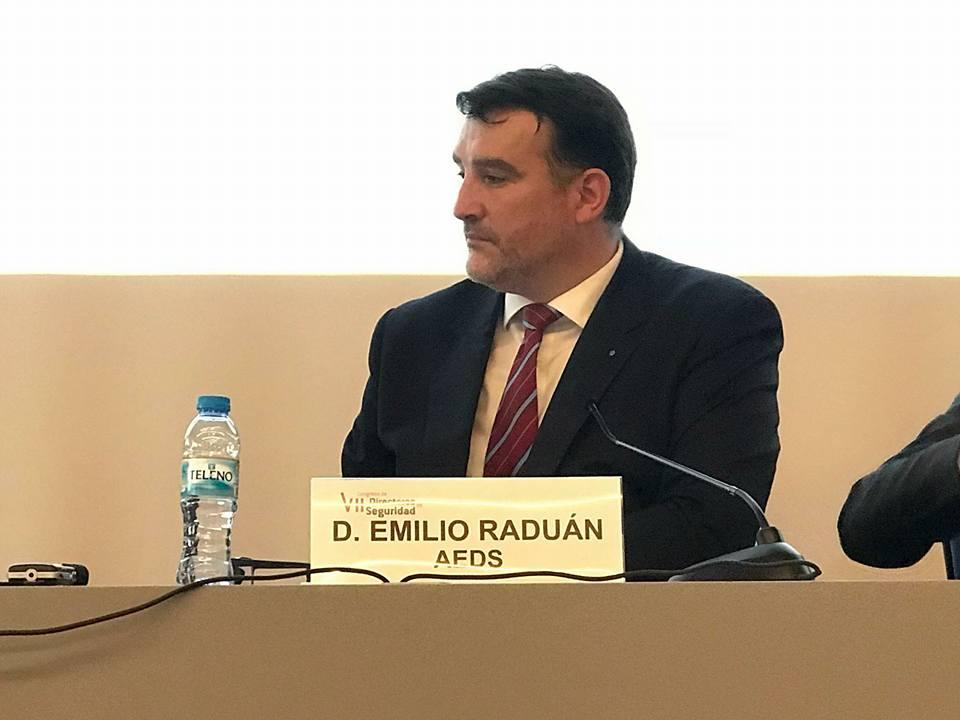
Emilio Raduán (AEDS): Technology makes it possible to tailor security to real needs


Hybrid threats, the updating of the regulatory framework and talent management are the main challenges currently shaping the agenda of Emilio Raduán Corcho, President of the Spanish Association of Security Directors (AEDS), who attended SICUR 2026. As an expert, Emilio emphasises the importance of ongoing dialogue with the police and security forces and technology and service providers, in order to tailor the services on offer to real needs at any given time.
Why should a culture of security be seen as an investment?
A culture of security should be seen not as a cost, but as an investment in corporate resilience. In a turbulent and ever-changing international environment, the ability to anticipate risks and manage them proactively ensures business continuity and the protection of our organisations’ people, assets and information.
At the AEDS, we will continue to work to uphold the dignity of, raise the profile of and strengthen the profession of security director as a key player in a company's overall security.
Which sectors is the AEDS active in, and what are its main objectives?
The AEDS brings together corporate and institutional security directors operating in the country’s main strategic sectors: critical infrastructure (transport, energy, water, healthcare), the financial sector, large-scale retail, mass events, cultural heritage and the social and healthcare sector.
By 2026, the key objectives are digitalisation and cyber resilience, continuing professional development and professional recognition. In the first area, the aim is to promote effective convergence between physical security and cybersecurity within organisations. As regards continuing professional development, the aim is to develop advanced training programmes tailored to new technological and regulatory threats. And, as for professional recognition, the aim is to ensure that the roles of security director is established as a strategic and indispensable figure within the management bodies of companies and institutions.
What issues are at the top of your agenda?
The main challenges are hybrid threats, updating the regulatory framework and talent management. As regards hybrid threats, it is important to bear in mind that today’s risks combine physical and digital elements. And, in this context, these issues must be addressed through a holistic, 360-degree security approach, in which the corporate security and IT departments operate within a single risk management framework.
In terms of updating the regulatory framework, legislative developments must keep pace with technological innovation. And when it comes to talent management, we need to attract and retain qualified professionals who are capable of managing highly uncertain environments and complex crisis situations.
What are the principles underpinning an efficient security ecosystem?
Ongoing dialogue is the cornerstone of an effective security ecosystem. This dialogue must take place with the police and security forces, and with companies in the sector. In terms of the first area, public-private partnership is not merely a complement, but a strategic necessity. Integration and the seamless exchange of information with the National Police, the Civil Guard and regional/local police forces greatly enhances the effectiveness of prevention.
It is also essential to maintain an open dialogue with technology and service providers in order to tailor the offering to the actual needs of end-user security managers.