




The importance of technology in public event safety


Alejandro García Martín, ambassador of the SEET Observatory, promoted by the AES Foundation, highlighted at the latest edition of SICUR the importance of electronics, digitalisation and artificial intelligence in public safety in entertainment, recreational activities and tourism.
He presented the observatory and explained various measures and approaches related to the cross-cutting integration of these technologies in mass event protection.
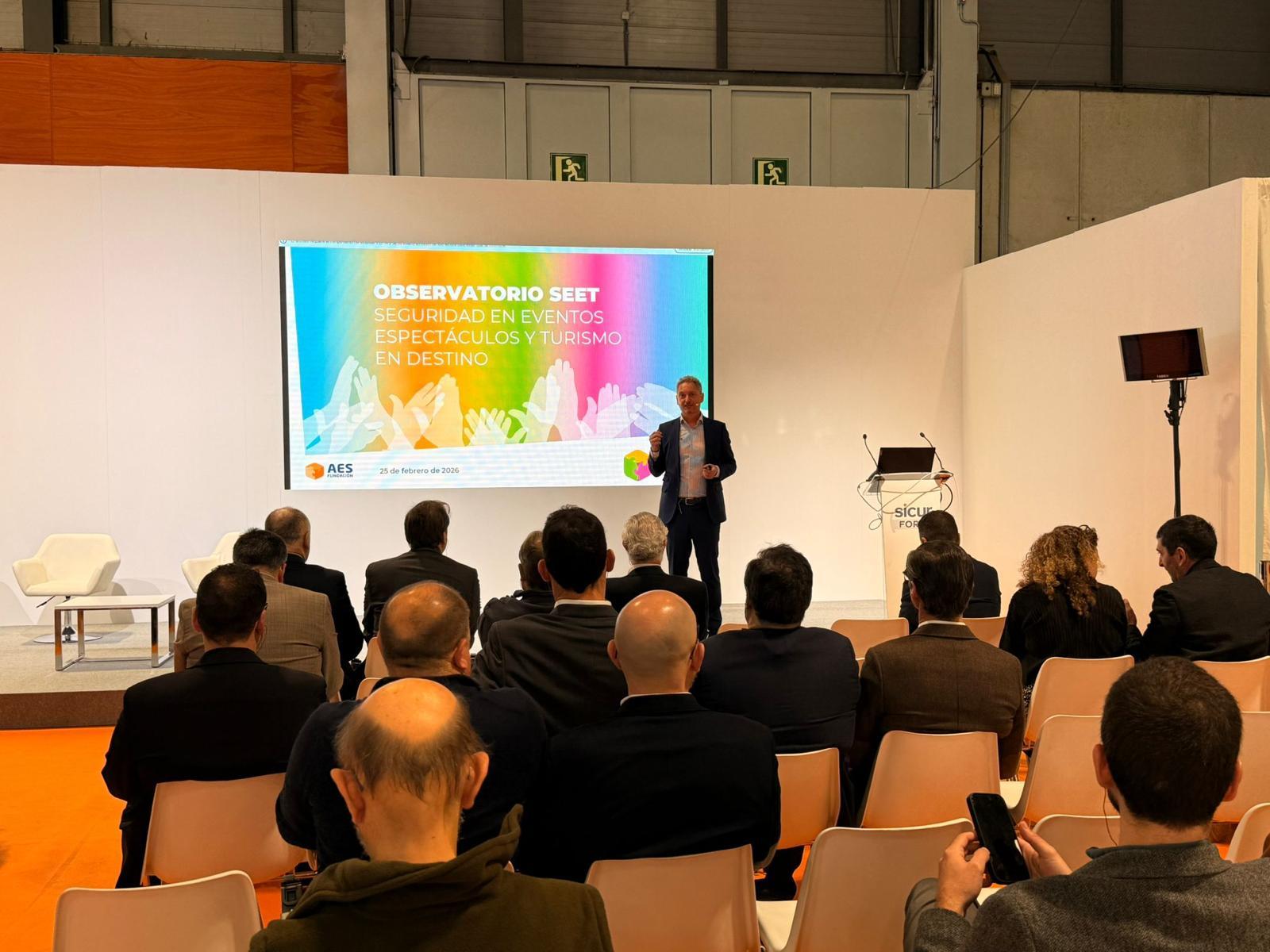
The ambassador of the SEET Observatory (Safety at Events, Shows and Tourist Destinations), promoted by the AES Foundation (Spanish Association of Security Companies), outlined various measures and approaches to ensure safety at events, structuring them mainly under the pillars of public safety and digitalisation. Its approach is based on a comprehensive cycle that includes anticipation and prevention, acting before incidents occur; planning, laying down prior protocols; immediate response, with the capacity to act during the event; and recovery, evaluation and inspection, with subsequent analysis to improve future protocols.
Alejandro García also proposed electronics and digitalisation as a fundamental cross-cutting layer for security at mass events, dividing it into four areas. Firstly, perception, with the use of technologies such as video systems, sensors, drones and capacity control systems; secondly, intelligence, with the implementation of data analytics and control centres to process information; thirdly, communication, with tools for the dissemination of alerts, public address systems and apps for attendees; and finally, integration, with the connection of the event's systems with the Smart City infrastructure.
He highlighted that safety measures are also defined according to the needs of the different groups involved. Thus, attendees require clear information, adequate signage and efficient evacuation protocols. Security managers need tools for real-time operation and incident logging to improve decision-making. Promoters seek risk reduction, value for money and legal compliance. And the Administration focuses on oversight, intervention and territorial integrity.
On the other hand, the ambassador of the SEET Observatory presented the "Security Guide at Mass Events", a document that will soon be published by the AES Foundation and that has the participation of the sector’s main companies.
Guide to Security at Mass Events
During the presentation, García also presented the main lines of development of the future "Guide to Security at Mass Events", a technical document promoted by the AES Foundation and developed with the collaboration of sector companies and professionals.
The guide aims to establish a reference framework for the planning, management and protection of large gatherings of people, especially events held on public roads and open urban spaces, where there is currently limited specific regulation on comprehensive security.
Among other aspects, the document will address issues related to operational planning, dynamic risk analysis, coordination between public and private actors, capacity management, technological integration, digitalisation of self-protection plans and the use of smart systems applied to security and emergency management.
The guide will also incorporate collaborative technical annexes aimed at compiling technological capabilities and solutions applicable to mass events, with the objective of promoting best practices, interoperability and common technical criteria for the sector.
Positive impacts
The application of advanced technologies to security at large-scale events generates specific positive impacts for all parties involved in the planning, operation and monitoring of large human gatherings.
Security managers have greater monitoring capabilities, operational traceability and real-time decision support through the integration of video surveillance, analytics, communications, crowd control and operational management platforms. Attendees feel a greater sense of security and benefit from a more agile response to incidents and emergencies. Promoters improve the optimisation of resources, reduce operational risks and strengthen the event's compliance and reputation. For their part, public administrations obtain valuable information related to mobility, occupation of public spaces, operational coordination and territorial management.
According to García, one of the objectives of the future "Guide to Security at Mass Events" will be precisely to promote a collaborative annex of technological solutions applied to the sector, aimed at compiling functional capabilities, integration architectures and use cases applicable to hhigh-attendance events.
For these solutions to be truly effective, interoperable and legally viable, it is essential to ensure common criteria for technological integration, cybersecurity, compliance and data protection. The systems deployed should allow integration with control centres and operational management platforms, as well as facilitate their connection with Smart City infrastructures and public emergency services, when necessary.
Furthermore, the use of security technologies shall strictly comply with the requirements of data protection, interoperability, cybersecurity and CE marking, ensuring the legality and reliability of the systems used for mass events.