




The sector calls for adaptation of regulations to new fire risks


Fire detection is no longer just about fire. It also applies to more complex buildings, new electrical loads, connected systems, photovoltaic installations or logistical environments that were not even covered by many regulations just a few years ago.
The sector is beginning to realise that many of the rules it has worked by for years need to be revised. This is the reflection of experts at the conference organised by Tecnifuego, together with the Catalan Fire Safety Cluster (Clúster de Seguretat contra Incendis de Catalunya, CLUSIC).
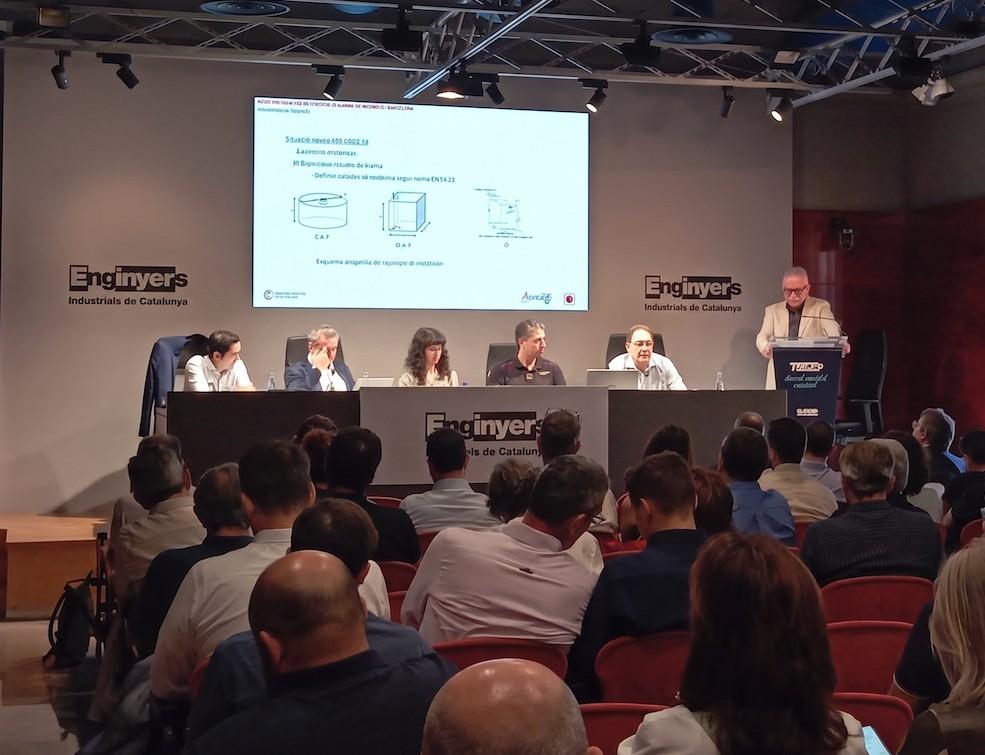
The 'Mesa de Detección', a conference organised in Barcelona by Tecnifuego together with the Catalan Fire Safety Cluster, brought together at the Col-legi d'Enginyers Industrials de Catalunya manufacturers, engineers, firefighters, specialists in regulations and installation companies to analyse how fire protection is evolving and what risks are beginning to worry the sector the most. Jordi Sans, president of the Safety Commission of the Col-legi Oficial d'Enginyers Industrials de Catalunya, and Mariano de Leonardo, president of CLUSIC, opened the meeting by focusing on the need to strengthen technical exchange and accelerate regulatory adaptation to a reality that is evolving faster and faster.
One of the most repeated messages was the gap between the speed at which the environment is changing and the capacity of regulation to adapt. Mariano de Leonardo warned that technology is advancing far ahead of regulation and defended the need to excelerate the adaptation of regulations and strengthen collaboration between administrations, associations and professionals to improve fire protection, especially in homes and among vulnerable groups.
Adaptation of regulations
Along the same lines, Lluis Marín, coordinator of Tecnifuego's Detection Committee, warned that many installations that once complied with the regulations now coexist with new energy loads and new uses for which they were not designed. "The buildings have changed and so have the installations. We can no longer take the premises of the past for granted," he said.
During his speech, Marín insisted on the importance of reducing detection and notification times in case of fire by advocating connected, properly maintained systems capable of verifying alarms effectively. He also discussed some of the scenarios that are currently of greatest concern to the sector, such as high-rise logistics, electric mobility and the rapid spread of smoke in certain residential environments and car parks.
Regulatory developments were another major theme of the meeting. Antonio Vinuesa, president of the Technical Committee for Standardisation CTN 23 SC3, reviewed the revision of the UNE 23007-14, an update that seeks to adapt the standard to technologies and needs that were barely present in buildings a decade ago: voice alarm systems, visual devices, connected detection, fire control panels and criteria for the useful life of detectors.
"Buildings and technology have changed a lot in recent years and the standard has to evolve with them," said Vinuesa, who also defended the need for regulations to be clearer, more practical and homogeneous for the whole sector.
Detection in houses
Detection in houses was another of the issues that generated most interest during the day. Esemel Valles, from Tecnifuego's Technical Area, explained the proposal that is being put forward to incorporate smoke detection in dwellings within the Technical Building Code, as well as additional requirements in high-rise residential buildings. "We are probably going to start with a minimum, but it is an important step forward," said Vallés, who identified the maintenance of these systems inside private homes as one of the great challenges still pending.
Guillem Larrubia, from the Barcelona Fire Department, stressed the importance of early detection to reduce fatalities, pointing out that "the main objective is to improve self-protection and prevent deaths". He also raised the need to review some criteria linked to high-rise buildings, taking into account the real operational limitations of external access for emergency teams. He also shared the experience of the Telecare service in Barcelona, where thousands of vulnerable homes now have detectors connected to a central station to speed up the response to fires or gas incidents.
Connected alarms and remote management
Connectivity and remote alarm management closed much of the day's technical discussion. The industry is already assuming that detection will increasingly shift towards models that are connected, supervised and able to continuously monitor the status of installations. The problem, many professionals agree, is that regulation is still advancing more slowly than technology.
Carlos Chicharro, Director of Active Protection at Tecnifuego, defended the need to organise and standardise the services associated with Fire Receiving Centres (FRC), an area in which the association has been working for some time with AESCRA, with tangible results such as the recent publication of a technical guide to move towards common criteria for supervision, alarm verification and communication with the emergency services. "Regulations are evolving, but slowly," said Chicharro, insisting on the need to provide greater regulatory clarity for this type of service.
This block also addressed some of the challenges that are beginning to appear in areas such as photovoltaics, performance designs or automated logistics, scenarios where the sector recognises that there is still a lack of sufficiently defined technical and regulatory criteria.
Óscar Escribá, vice-president of AESCRA, called for a clearer legal and operational framework for FRC services and warned that "in Spain there is a great culture of intruder alarms, but the same has not happened with fire alarms". Escribá also insisted on the need for homogeneous verification protocols and specialised operators to reduce false alarms and improve emergency response.
The meeting served to highlight the extent to which fire detection is entering a new phase, much more closely linked to continuous monitoring, data management and risk anticipation.