




Rafael Marqués (Prolians Metalco): Measuring staff wellbeing enables us to anticipate risks


Modern prevention can no longer be limited to simply checking that a piece of equipment provides protection or that an evaluation has been carried out. The next step is to assess how an individual experiences their role, convert that experience into data, and take action before accidents, sick leave, staff turnover or health problems arise. This was explained by Rafael Marqués, Commercial Director for PPE and workwear at Prolians Metalco, at a series of Occupational Safety Training events held recently in Barcelona.
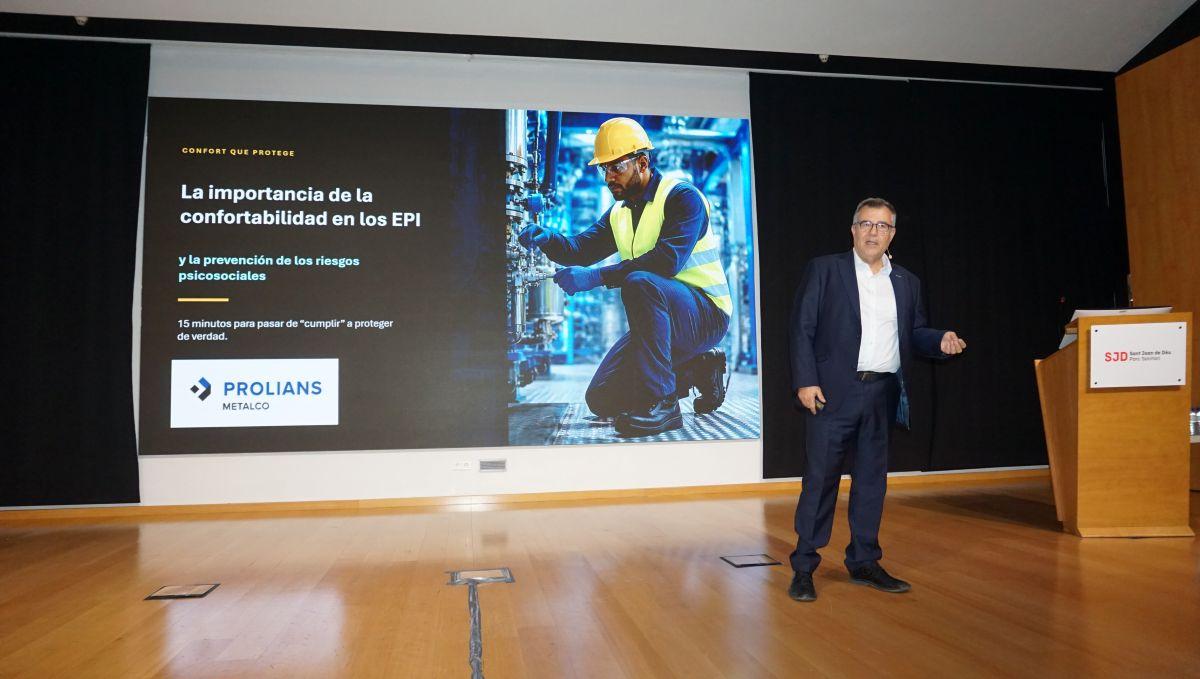
As Rafael Marqués of Prolians Metalco explained, personal protective equipment may meet the technical requirements but still fail to cope adequately with the real conditions of the workplace. “Comfort is not a secondary consideration: it has a direct influence on the acceptance, correct use and continued use of PPE.” When a piece of equipment is uncomfortable, heavy, restricts movement or reduces sensitivity, the wearer tends to reposition it, adjust it constantly or even remove it for part of the task. "That day-to-day friction can reduce protection and also affect performance."
For this reason, choosing the same product for the entire workforce is rarely the best solution. “Requirements vary depending on the activity and the level of risk: someone who walks all day does not need the same footwear as someone who remains in a static position; nor does someone who handles small parts need the same gloves as someone who works with large components. Tailoring PPE to the job allows for a balance between protection, ergonomics, mobility and precision.”
Measuring and making decisions based on data
Digitalisation makes it possible to assess this experience through surveys tailored to each PPE category and each post. “The questions may cover fit, weight, breathability, freedom of movement, ease of putting the item on or sensitivity, and may also include environmental factors such as lighting, temperature, ergonomics and perceived safety. "The result is well-organised and comparable data, not an isolated impression."
A dashboard featuring indicators and colour-coding provides an overview by centre, department, role or body area, and allows you to then drill down to the specific product or group requiring attention. “Health and Safety, Prevention and Human Resources can thus prioritise measures, monitor progress and justify decisions using objective data.” “Measurement is no substitute for technical judgement: it reinforces it and makes monitoring easier.”
Psychosocial risks
This same approach is particularly valuable in the psychosocial sphere, where problems often only become apparent once they have already affected health or the organisation. “Psychological demands, the work-life balance, control over one’s work, social support and leadership, rewards and social capital are among the key factors that should be examined in a structured manner.”
New technologies, work overload, mental fatigue, the way work is organised and a lack of support can all become risk factors. “Assessing them using digital software based on recognised methodologies, such as FPSICO or COPSOQ, helps identify areas for improvement while respecting confidentiality and working with sufficiently large groups to ensure anonymity.”
Continuous improvement cycle
The true value of a digital tool lies not merely in carrying out an assessment, but in completing the entire cycle: tailoring the assessment to the organisation’s structure, collecting responses, analysing the results, defining actions, assigning responsibilities and measuring progress again. “This traceability enables us to determine whether the decisions taken are working or whether we need to change course.”
Data-driven prevention offers benefits that go beyond regulatory compliance, encompassing promoting the correct use of PPE, reducing discomfort and disruption, helping prevent long-term health problems, and helping reduce absenteeism and staff turnover. At the same time, it can enhance the working environment and the employer brand – two factors that are becoming increasingly important for attracting and retaining talent.
Marqués concluded by pointing out that the central idea is simple: what is measured can be managed and improved. “Listening to people, tailoring protection to each activity and monitoring changes in psychosocial factors turns prevention into a proactive tool. It is not a question of waiting for a problem to arise, but of having reliable information so that we can take action ahead of time. “Measure, decide, monitor and measure again: that’s the path to safer, healthier and more sustainable organisations.”