




Technology in the Service of Firefighting


Technology should be an ally in the fight against fire, as explained by Rafael Reyes, an officer in the Fire Prevention Area of the Fire Department of the Community of Madrid.
This expert highlights the positive results being achieved through the use of drones in the monitoring and control of wildfires, roof fires and industrial warehouse fires. However, he also warns about new risks related to electric vehicles, new green roofs and ventilated façades.
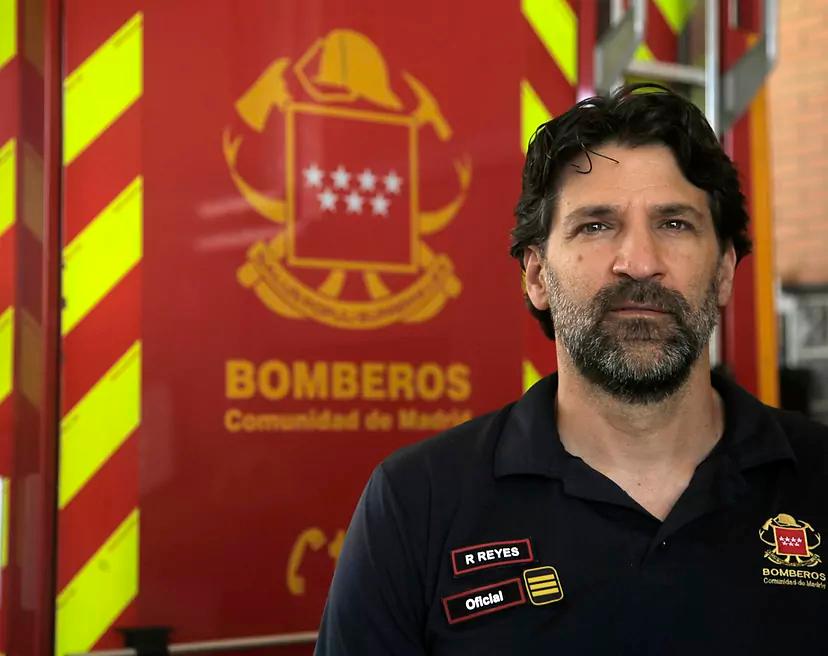
Certain technological advances have become indispensable allies in the fight against fire, as Rafael Reyes, an officer in the Fire Prevention Unit of the Madrid Regional Fire Service, explains. He notes that “all the resources we have are continuously being updated; among them, we include a drone unit that is achieving very good results in monitoring and controlling fires, especially when they are wildfires, roof fires or industrial warehouse fires, and when we do not have helicopters available at that moment.”
But other technological advances can also become a source of new risks. This is evident in fires involving electric vehicles, which, according to Reyes, “are generating many complications.” For this reason, “both technical experts and specialists, as well as representatives from car companies, are already collaborating and working together to solve this problem.”
Other developments that are under fire services’ scrutiny include new green façades and roofs on buildings, as well as ventilated façades with combustible materials, “which pose a challenge for us because we have to adapt our resources and procedures to them.” In this regard, the expert warns that “the energy efficiency and sustainability policies being pursued in society may generate certain risks, so regulatory and technological development should go hand in hand and take fire risks into account.”
Changes in wildfires
Regarding forest fires, Reyes highlights several changes that have clearly affected how they develop. “The forest is increasingly underused; we no longer use natural resources such as firewood or charcoal, and this leads to an accumulation of combustible material. As a result, when a fire occurs, it is more explosive and spreads more quickly.” In addition, “the abandonment of rural areas means that roads are not maintained either, making access to certain areas more difficult.”
For this reason, “it is essential to raise awareness among rural populations so that they take simple measures that can stop the spread of a fire, such as properly managing plots of land and residential developments to prevent fire continuity from one area to another. This can be achieved, for example, by avoiding the spread of arizónica hedges.”
Collaboration
The Madrid Fire Department officer also emphasises the importance of cooperation with other emergency services and institutions in the fight against fire. “In terms of regulatory development, we are working with the Fire Departments of Madrid City Council and the Government of Catalonia, as well as those of Barcelona, Zaragoza, and Valencia, among others, to make joint proposals.” He also explains that “we have cooperation zones with the provinces bordering Madrid where we intervene and send resources.” Likewise, “there is a collaboration agreement between the regional and municipal fire services in Madrid, with a shared operational area.”
At the international level, “we have ERICAM (Emergency and Immediate Response of the Community of Madrid), an operational intervention unit capable of responding to any large-scale emergency that may occur either in another Spanish region or anywhere in the world.”