




Alfons Gómez Rosselló (Balearic Islands): Fire safety regulations need to be updated


Fire safety in hotels was the focus of the 1st Balearic Islands Fire Safety Day, recently organised in Mallorca by the Spanish Association of Fire Protection Companies (Tecnifuego) and CEPREVEN, in collaboration with ASINEM and ASELF. Speaking on behalf of the Government of the Balearic Islands, Alfons Gómez Rosselló, Director-General for Industry and Industrial Estates, highlighted the need to update fire safety regulations; while Pablo Gárriz, Director-General for Emergencies and Home Affairs, underlined the importance of safety plans and coordination between the stakeholders involved in an emergency.
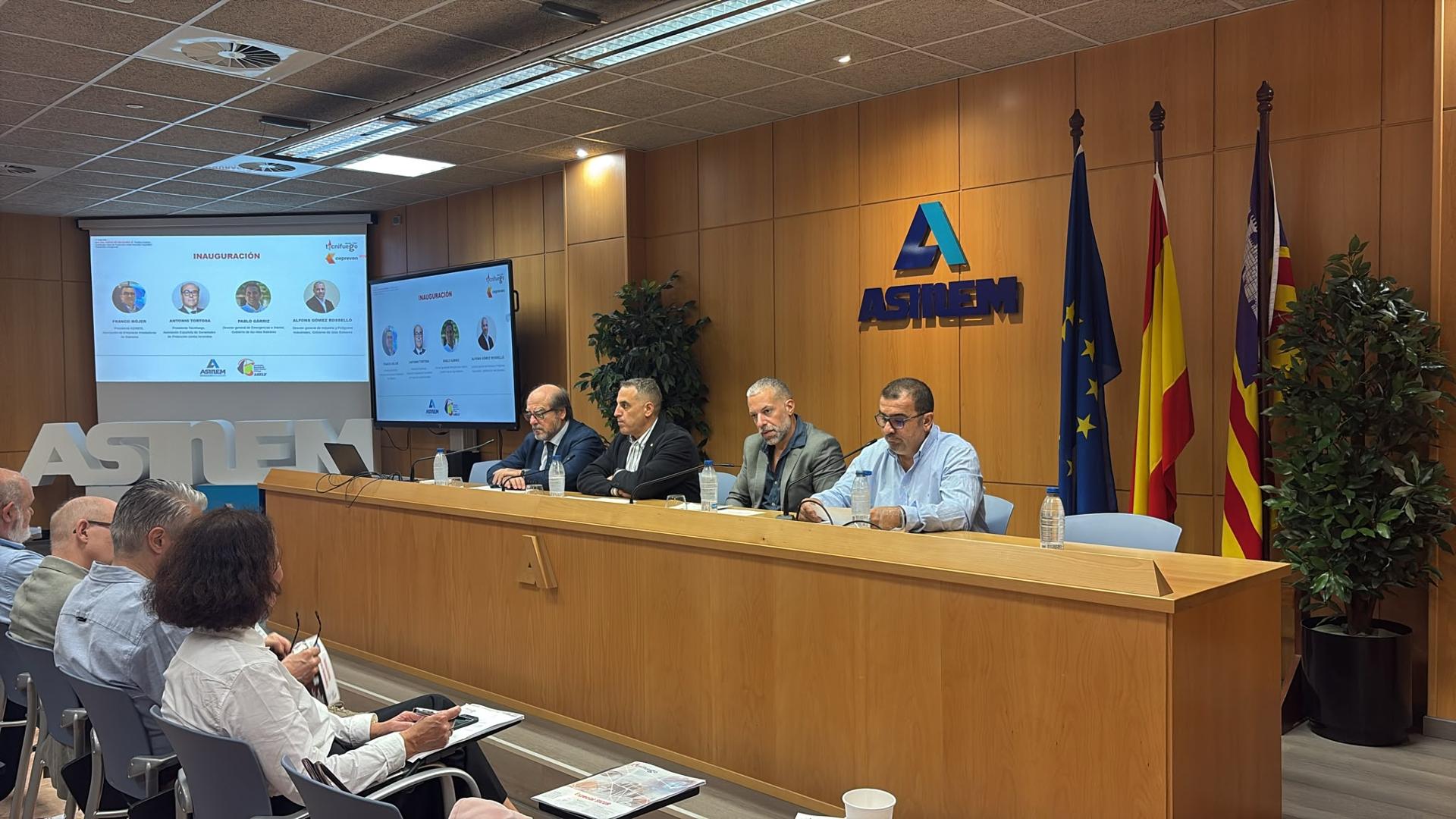
The event, held in Marratxí (Mallorca), brought together representatives from the government, fire safety specialists and professionals from the hospitality sector to analyse safety in establishments with high occupancy rates, round-the-clock activity and guests who, in many cases, are unfamiliar with the premises.
Spanish hotels recorded more than 48.7 million overnight stays in August 2026, according to provisional figures from the National Statistics Institute. The Balearic Islands had the highest occupancy rate by bed, at 90.3 per cent. In establishments of that nature, safety measures must take into account both the condition of the building and the occupants’ ability to respond in the event of an emergency.
Franco Mójer, president of ASINEM, emphasised the importance of prevention and the correct maintenance of facilities in a region where tourism plays a vital role. “Because the best fire safety measure is one that never needs to be put into action; and the second-best is one that responds effectively when needed,” he said.
The need to ensure that protection measures are tailored to the specific characteristics of each premises was also one of the points raised by Antonio Tortosa, President of Tecnifuego, who pointed out that while compliance with regulations is essential, it does not in itself guarantee the highest level of safety.
Regulation and simplification
Speaking on behalf of the Government of the Balearic Islands, Alfons Gómez Rosselló, Director-General for Industry and Industrial Estates, highlighted the need to update fire safety regulations and explained that the administration is working to streamline administrative procedures. For his part, Pablo Gárriz, Director-General for Emergencies and Home Affairs, emphasised the importance of protection plans and coordination between the various agencies involved in responding to an emergency.
One of the principal difficulties in hotels is evacuation. Guests need to quickly understand what is happening and how to respond in a building they are generally unfamiliar with, a situation that becomes more complicated at night. “In a hotel, waking up and deciphering a message can take longer than walking down a corridor,” explained Rafael Sarasola, Passive Protection Coordinator at Tecnifuego.
Santos Bendicho, a member of the Regulatory and Technical Coordination Committee at Tecnifuego, emphasised the importance of self-protection plans, signage and obstacle-free evacuation routes. He also warned of the danger posed by the spread of smoke, which could jeopardise evacuation before the flames reach certain areas of the building.
Drawing on his experience in the hotel industry, Marcos Villar, Security & Safety Manager at the Four Seasons Resort Mallorca at Formentor, emphasised the importance of staff training, particularly given the seasonal nature of the workforce and the impossibility of predicting how guests will react. He explained that, at holiday resorts where facilities may be spread out or situated near woodland areas, staff must be prepared to take action until the emergency services arrive. He also championed drills as an opportunity to identify shortcomings and improve the response.
Safety can also be compromised by everyday practices such as blocking fire doors or using evacuation routes to store materials. Renovations may also alter the building’s compartmentalisation or affect the operation of detection systems.
Risks associated with electrification
The conference also addressed the risks associated with electrification, given the growing number of photovoltaic installations, energy storage systems and electric vehicle charging points. Mónica García de la Morena, from the Tecnifuego Fire Extinction Committee, explained that fires involving lithium-ion batteries can lead to thermal runaway and the release of flammable gases. In light of these situations, she argues for the need to use protection systems that are backed by testing and suited to the characteristics of each installation.
The need to review protection systems as risks evolve was another of the issues raised. Lluís Marín, Detection Co-ordinator at Tecnifuego, drew attention to the age of some installations and the need to consider upgrading them, both in light of technological advances and the potential obsolescence of the equipment.
Speaking on behalf of the Balearic Islands Emergency Service, Pedro Ladaria, the Balearic Islands’ Emergency and Civil Protection Co-ordinator, explained that they are calling for the new self-protection plans to include an operational fact sheet containing essential information for emergency response teams. He also argued that these services should be involved from the design stage of buildings to avoid difficulties with subsequent work.
Complying with the regulations does not always mean being prepared to deal with a fire. This was one of the key messages of the event, which emphasised the need to understand the real risks faced by each hotel and to ensure that their protective measures are appropriate to those risks.