

Horror and fantasy film screenwriter: how to prepare for this career


Writing horror and fantasy films requires much more than simply imagining monsters or devising a plot twist. The professional task involves turning an idea into a clear, producible and emotionally effective audiovisual narrative. To achieve this, beginners need to master the screenplay format, learn how to construct scenes and characters, understand the rules of the genre, and develop a routine of writing and rewriting. MADHORROR, IFEMA MADRID’s festival of horror, dark fantasy and Halloween culture, offers a natural setting for exploring the creative trades within the genre. Its official programme includes presentations, masterclasses, panel discussions, workshops and educational sessions on film, comics, video games and visual culture. The 2026 edition will take place from 30 October to 2 November at IFEMA MADRID.
What does a horror and fantasy film screenwriter do?
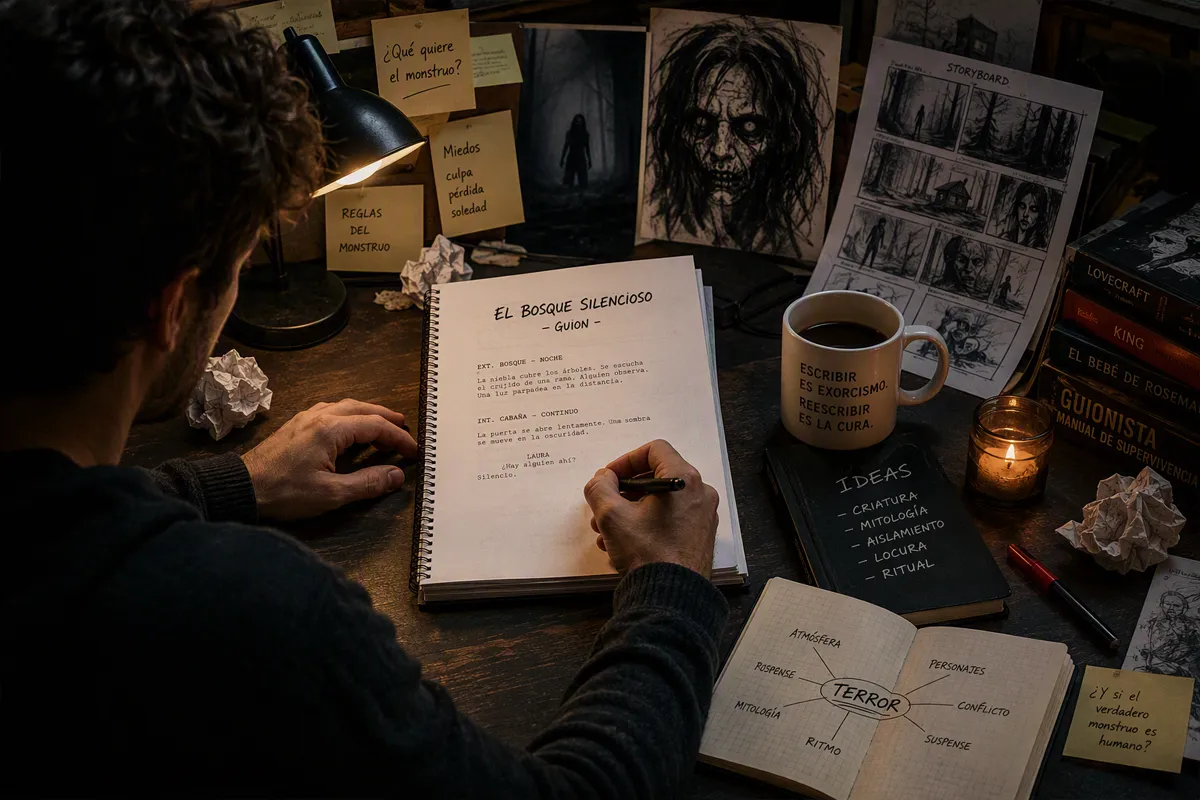
The screenwriter develops the story that will serve as the foundation for an audiovisual production. They define the premise, the characters, the conflict, the dramatic progression and the scenes. They also write the actions and dialogue in a format that allows the rest of the team to interpret what should be seen and heard on screen.
In horror, the script must manage information, anticipation and threat. In fantasy, it must also establish internal rules so that the extraordinary feels coherent. A creature, a curse or an impossible world may be highly original, but they only work if they affect characters with recognisable objectives and if the story maintains its own internal logic.
A screenplay is not a shortened novel either. Its writing is visual and economical. Every scene needs a dramatic function and must contribute an action, a decision, a revelation or a change that moves the story towards the next point of conflict.
Training: what is worth learning before writing a feature film
There is no single mandatory qualification required to work as a screenwriter. Training may come from audiovisual studies, film schools, specialised courses, workshops or self-directed learning. What matters is acquiring verifiable skills and applying them to completed projects.
The training programmes reviewed agree on several core subjects: audiovisual language, development from the initial idea to the literary screenplay, narrative structures, characters, dialogue, treatment, beat sheet and professional project presentation. Some programmes also include sales dossiers and pitching, because writing the story and knowing how to communicate it are different stages of the profession.
Training provides tools and feedback, but it does not replace practice. A useful path combines theory, reading produced screenplays, analysing films, writing scenes and reviewing them with others. Improvement comes when the writer can identify what a sequence was intended to achieve and what the reader actually understands.
Understanding the genre to find your own voice
Horror includes traditions and subgenres with different expectations: supernatural, psychological, slasher, folk horror, body horror, science fiction horror and cosmic horror, among others. Understanding their conventions helps identify what a story promises and which elements require a personal variation.
Solid preparation does not mean copying formulas. It means studying how different films build threat, isolation, uncertainty and escalation. The central fear should be connected to the characters and the theme. When the external conflict reflects a loss, guilt, obsession or internal vulnerability, tension usually gains greater depth.
In fantasy, the consistency of the world is equally important. The rules may be strange, but not arbitrary. The screenwriter must decide what can happen, what the cost is, what the protagonist does not know and when the audience receives each piece of information.
The skills that separate an idea from a professional screenplay
Visual writing and format
The reader should be able to imagine the film through specific actions. Descriptions need to be clear, concise and filmable, and the format must allow scenes, characters and dialogue to be located effortlessly.
Structure, pacing and beat sheet
Before drafting every scene, it is advisable to organise the main events. The beat sheet makes it possible to check the progression of the conflict, balance information and identify repetitive stretches or sections without consequences.
Characters with objectives and decisions
The audience needs to understand what the protagonist wants, what they could lose and why they cannot walk away from the situation. In horror, characters’ decisions support the credibility of the threat.
Rewriting and the ability to receive feedback
The first draft serves to discover the film; subsequent drafts allow it to become readable, coherent and producible. Receiving feedback does not mean accepting every change, but rather identifying problems perceived by several readers and finding the right solution.
Production awareness
Understanding locations, effects, the number of characters and technical requirements helps align ambition with the type of project. This awareness is especially useful when writing short films and first independent works.
A practical path to preparing for the profession
The journey can be organised through projects of increasing difficulty. The goal is not to accumulate ideas, but to complete materials that demonstrate the ability to write and rewrite.
- Read professional screenplays and compare them with the finished film to observe what was on the page and what decisions came later.
- Write a logline that summarises the protagonist, objective, conflict and distinguishing element.
- Turn the idea into a synopsis and then into a beat sheet, checking the progression of each sequence.
- Complete a producible short film before tackling a feature film, and review it with trusted readers.
- Prepare a concise portfolio featuring the best completed projects, each accompanied by a logline, synopsis and essential information.
- Practise presenting the project orally and prepare a clear dossier without promising elements that the screenplay does not yet contain.
- Learn about calls for submissions, labs and festivals, always reviewing their rules, rights conditions and official deadlines.
How to build a useful portfolio
An initial portfolio does not need to include many texts. It is more effective to present a small number of completed and distinctive pieces: for example, a short film, a feature film sample and a series proposal. Each piece should be proofread, properly formatted and accompanied by a brief explanation of its genre and stage of development.
It is also advisable to keep records of different versions and maintain traceability of revisions. This helps explain the creative process and prevents confusion between drafts when the project receives feedback from multiple people.
Before submitting a screenplay to a competition or production company, it is necessary to check the participation and intellectual property conditions. Not all opportunities require the same documents or offer the same framework for the project.
MADHORROR as a place to understand the genre from the inside
The official presentations and workshops area of MADHORROR is designed as a space for themed talks, masterclasses, panel discussions, practical workshops, training sessions, podcasts and live conversations. The programme covers film, comics, video games and visual culture, allowing attendees to see how screenwriting connects with other creative disciplines.
For those aspiring to write horror or fantasy, attending professional events can help them learn production terminology, discover the processes of other departments and ask specific questions. The value lies not only in seeking contacts, but in gaining a better understanding of how a written idea becomes a collaborative work.
Discover the MADHORROR presentations and workshops area: https://www.ifema.es/en/madhorror/areas/presentations-workshops
Key facts and insights for future screenwriters
- Screenwriting training typically covers the idea, synopsis, treatment, beat sheet, scenes, characters, dialogue and project presentation.
- Horror requires work on anticipation, atmosphere, threat and escalation, as well as characters with understandable objectives.
- A portfolio should prioritise completed, revised and clearly presented projects.
- MADHORROR 2026 will take place from 30 October to 2 November at IFEMA MADRID.
- The MADHORROR presentations and workshops area includes talks, masterclasses, panel discussions, practical workshops and training sessions.
Frequently asked questions about the horror screenwriting profession
Is it necessary to study film to become a screenwriter?
There is no single mandatory qualification. However, it is necessary to learn audiovisual language, format, structure, characters, scenes, dialogue and rewriting, whether through formal education, courses, workshops or guided practice.
What project is best to start with?
A short film allows you to practise a complete structure and adapt the story to limited resources. Afterwards, the portfolio can be expanded with feature film or series samples.
What should an initial portfolio include?
A small number of completed and revised pieces, accompanied by a logline, a brief synopsis and a clear indication of the format, genre and status of the project.
How does understanding horror subgenres help?
It allows writers to understand audience expectations, recognise conventions and decide which elements will be preserved, combined or transformed into an original proposal.
What does MADHORROR offer people interested in creative work?
The official website announces presentations, masterclasses, panel discussions, practical workshops, training sessions, podcasts and conversations related to the creative mechanisms of the genre.
In summary
Preparing to become a horror and fantasy screenwriter requires learning audiovisual storytelling, completing projects, receiving feedback and rewriting. Understanding the genre helps manage audience expectations, but an individual voice emerges by connecting fear or the extraordinary with specific characters and conflicts. A concise portfolio of completed work, supported by a clear presentation, is more effective than a collection of undeveloped ideas. MADHORROR 2026, taking place from 30 October to 2 November at IFEMA MADRID, offers an environment of presentations, workshops and networking opportunities to explore the creative processes behind horror and fantasy.