

Port of Suape (PE) working to regain its leading role in the export of Brazilian fruits.
Port of Suape (PE) working to regain its leading role in the export of Brazilian fruits.
Written by Marcio Guiot | CEO of the Port of Suape
The fruit production sector in Brazil is one of the country's main economic activities, primarily based on the great diversity of varieties, which vary according to region and climate. In terms of production scale, we are the third largest fruit producer in the world, behind only China and India.
When we move towards the global market with an emphasis on foreign trade, fruit farming is a fundamental topic on the world economic agenda, since, when we address the issue of fruit production and marketing, the question of food security arises, that is, access to quality food, in sufficient quantity and on a regular basis.
When we analyze the production and marketing characteristics of Brazilian fruits, we find the following scenario: The European Union, the USA, and the United Kingdom are the main buyers of Brazilian fruits.
Brazilian fruit exports in 2023 reached US$1.35 billion, the highest in the historical series. Since 2019, Brazilian fruit exports have exceeded US$1 billion, with an increase of 24.51 billion last year. The main destination for Brazilian fruit exports is the European Union. Approximately half of the total value of fruit exported by Brazil is destined for the European bloc.
The sector accounts for 16% of all agribusiness labor, according to the Brazilian Association of Fruit and Derivative Producers and Exporters (Abrafrutas). The most exported fruits from Brazil are: mango, melon, grapes, lemon, and limes.
Upon arriving in Pernambuco, we know that the state is one of Brazil's main fruit exporters, especially mangoes and grapes. In fact, the state stands out as the largest exporter of these fruits in Brazil.
Concentrated mainly in the São Francisco Valley, with Petrolina as its main hub, the fruit growing sector continues to grow in terms of production value and associated GDP. Other municipalities make up the region known as the Sertão do São Francisco: Afrânio, Cabrobó, Dormentes, Lagoa Grande, Orocó, and Santa Maria da Boa Vista.
In this scenario, port infrastructure is characterized as one of the main factors for the export of products from the fruit growing sector, and some port complexes have consolidated themselves in recent years in relation to the world fruit transport market, such as the Port of Pecém (CE) and the Port of Salvador (BA).
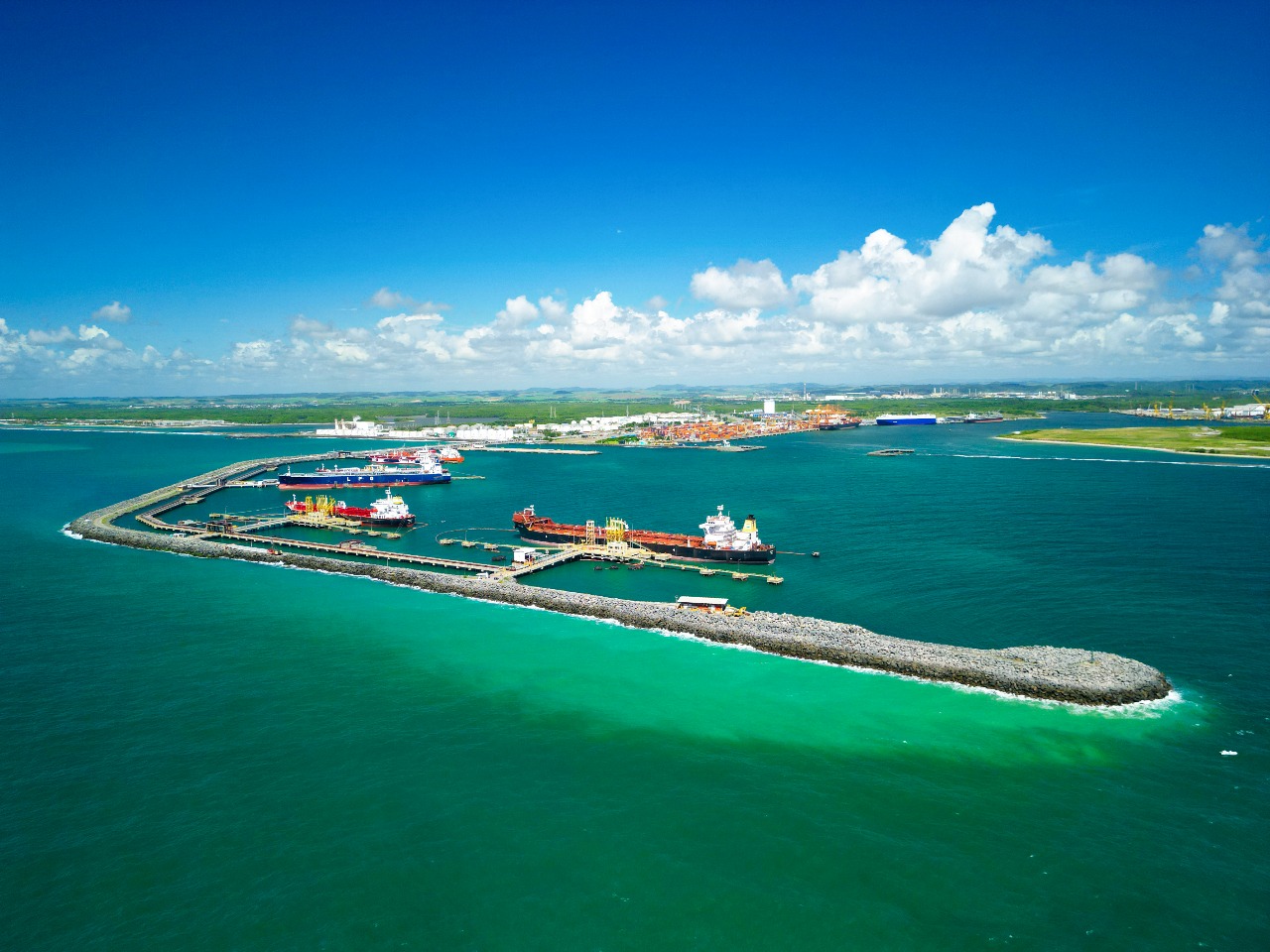
The Port of Suape (PE) is working to regain its leading role in fruit exports, especially those produced in the São Francisco Valley. Aware of the need to capture this type of product, Suape's management has been working tirelessly to make our port a key player in the transportation of fruits produced in the state.
It is in this context that the dredging of the outer channel was carried out, a project that resulted in deepening it to 20 meters. Started on December 1, 2023, the completion of the project cost R$ 140 million and resulted in the removal of 1,700,000 cubic meters of sediment, following a strict schedule of activities licensed by the relevant authorities.
Once these projects are completed, the dock will be able to receive large vessels, such as the Suezmax tanker, at its maximum capacity. The intervention was completed after four months of work using state-of-the-art dredgers.
Dredging of the inner channel will begin soon. This service is essential to allow the safe docking of 366-meter-long container ships and other world-class vessels with maximum cargo capacity. The dredging of the channel, which will be deepened to 16.2 meters, is expected to take six months and will remove 3.8 million cubic meters of sediment. The same contract includes dredging and maintenance of the turning basin and Liquid Bulk Piers (LBPs) 3A and 3B, for deepening to 18.5 meters.
The intervention has a cost of R$199,722,311.71, with R$100 million coming from the Ministry of Ports and Airports through the Economic Acceleration Program (PAC3), and R$99,722,311.7 from the state's own resources.
Suape guarantees the necessary infrastructure for new ventures to establish themselves in the state-owned company, such as the arrival of a second container terminal, enabling the creation of new routes, such as the Santana Service, connecting Suape to the Asian continent, which is already a... The reality operated by Tecon Suape. The aim is to become more competitive and increase its global market share through competitive advantages such as attracting world-class ships to use the port at maximum capacity and cargo, positioning the Pernambuco port as an attractive destination for fruit exports.


