


Fruit Attraction: With support from the São Paulo State Government, fruit farming in São Paulo gains ground in the international market.
Fruit Attraction: With support from the São Paulo State Government, fruit farming in São Paulo gains ground in the international market.
During the event, the São Paulo State Department of Agriculture signed a technical cooperation agreement with Seagri focusing on the production of red fruits.
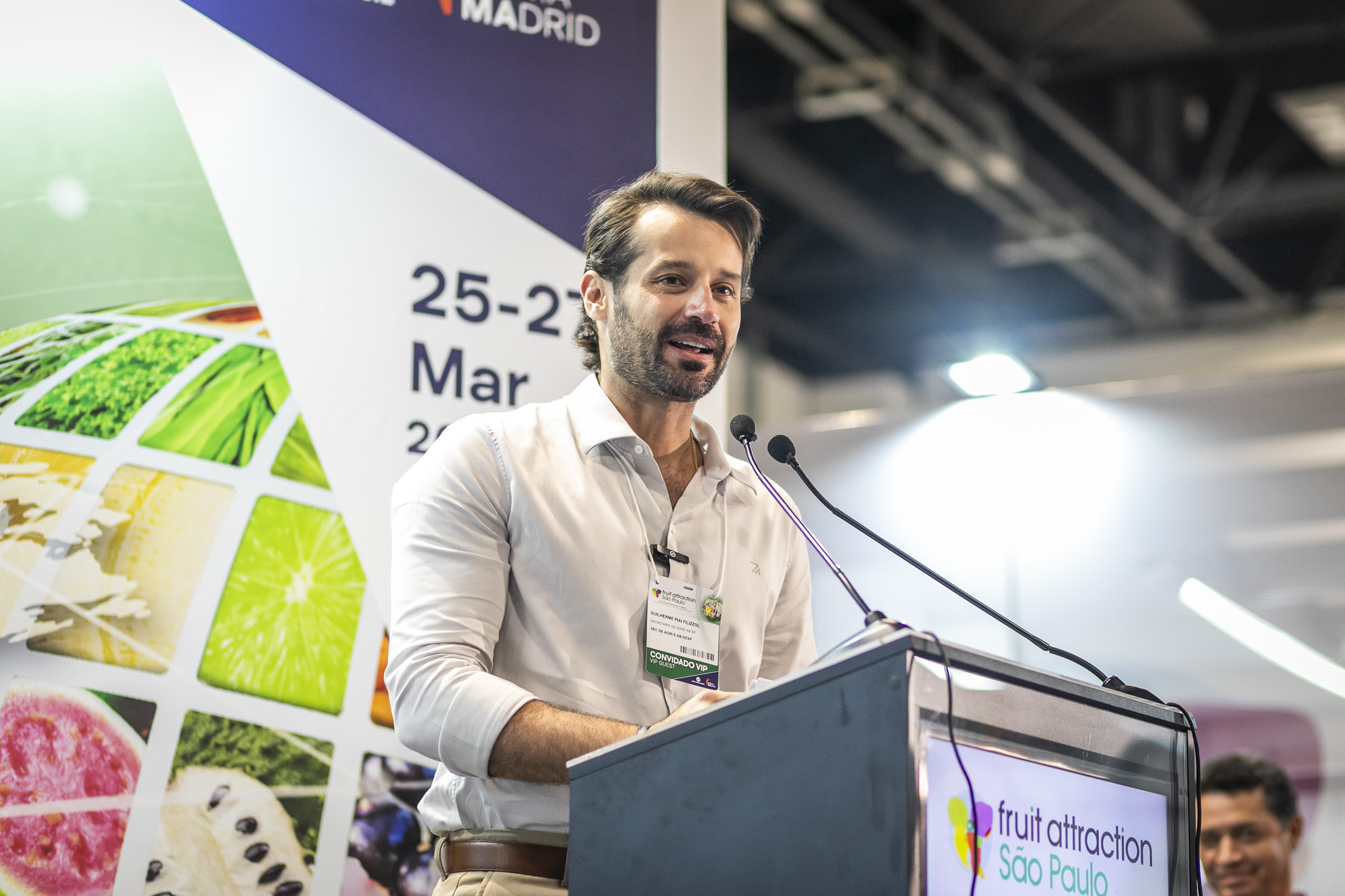
With the goal of promoting the international growth of fruit farming in São Paulo, the State Secretariat of Agriculture and Supply of SP participated in the opening of Fruit Attraction SP 2025, the main international fruit and vegetable fair in Latin America, this Tuesday (March 25th), in the capital of São Paulo.
On this occasion, the São Paulo State Department of Agriculture signed a technical cooperation agreement with the Department of Agriculture, Supply and Rural Development of the Federal District (Seagri) focusing on the production of red fruits. The partnership covers personnel training in strategic areas, mutual technical assistance, and data sharing, aiming at the development of family farming projects.
“Fruit farming adds value, boosts the economy, generates jobs, and preserves the environment. Brazil has enormous potential not only to lead the process of food security in the world, but also in energy transition and mitigating the effects of climate change. São Paulo is the state with the greatest crop diversification in Brazil, which allows us to lead the Brazilian trade balance even in difficult years with severe drought,” highlighted the Secretary of Agriculture and Supply, Guilherme Piai.
It is worth highlighting that the State of São Paulo is the main national producer of fruit, exporting more than 250 million tons per year, according to data from the Institute of Agricultural Economics (IEA – Apta), linked to the SAA. In 2024, São Paulo's fruit production registered a growth of 131 tons compared to the previous year. Citrus products alone accounted for 501 tons of exports, with 112,000 tons exported. Furthermore, the juice group is the second largest exported in the trade balance, accounting for 14.2 million tons, totaling 573.74 million tons, of which 98.6 million tons correspond to orange juice.
With a diversified fruit production, São Paulo also leads in banana production, with 26% of the total produced in the country, and avocado production, with 40%. Other highlights include persimmon, mango, papaya, guava, and fig. During the fair, the Secretariat of Agriculture, through its coordinating bodies — APTA, CATI, Agricultural Defense — and the Sectoral Chambers, presents the main initiatives of the São Paulo government for the development of fruit production in São Paulo.
Among the initiatives is the São Paulo Red Fruits Project, which encourages the production of blueberries, raspberries, and blackberries in São Paulo state, with an emphasis on family farming, bringing income and crop diversification to the countryside, as well as transmitting innovation and extension services to producers. In addition, there is the São Paulo Cocoa Project, which aims to boost cocoa farming in the state. In 2025, 34,300 new cocoa trees were planted, an increase of 37,831 TP3T compared to 2024.
At Fruit Attraction, the Agricultural Defense Coordination (CDA) presented phytosanitary certification of origin actions that enable the export of products from São Paulo. The registration and supervision of Tahiti lime plantations make São Paulo the largest exporter in the country, with more than 601 TP3T of the acid lime exported. With the opening of the Japanese and Chilean markets in 2025, the Agricultural Defense began registering and monitoring Hass avocado varieties on farms and packing houses that process this fruit. Currently, 5 farms and 5 packing houses are registered.
The São Paulo Agribusiness Technology Agency (Apta) presented to visitors at the fair the genetic improvement of the Agronomic Institute (IAC-Apta) with tropical and subtropical fruits, such as grapes, blackberries, peaches, macadamia nuts, persimmons, citrus fruits, bananas, passion fruit, pineapples, among others. The Biological Institute (IB-Apta) brought to Fruit Attraction research in plant health, with studies on pests and diseases that affect fruit crops.
It is worth remembering that the Department of Agriculture, through the São Paulo Agribusiness Expansion Fund (FEAP), has a credit line of R$10 million aimed at fruit growing with an annual interest rate of 31%, an 84-month term, and a 24-month grace period.


